Friday, 21 November 2025

Potter Grange Goole

Winter is here, it's dark around 4pm  and this week we have had snow. I  picked up some of our Russet and Bramley apples and put them outside in the porch for people to take away - I have never seen the trees so laden.  But I think the windfalls will now provide winter food for the birds I have seen lots of interesting mushrooms and toadstools in the garden -  but not any giant puffballs which we used to - sliced they went very well with fried bacon!

Inside I have been sorting out my collection of old photos and trying to catalogue them.  I have hundreds. Some are old press pictures from the Goole Times whilst many are early postcards which I have bought. Others have been donated by people who know of my interest and have either given me pictures or allowed me to scan theirs.

The majority of my photos are of Goole and Howden but I have a good collection of local villages. Most villages are well represented - Airmyn, Swinefleet, Eastrington, Barmby, Gilberdyke, Newport, Saltmarshe, Laxton etc [this is not an exhaustive list!!]. But some villages seem to have avoided the camera - for example I have postcards of Sandhall but not Kilpin; postcards of Newsholme and Portington but not of Sandholme. But I go to postcard fairs and hope one day to find views of some of these places.

I am enjoying doing some research at the moment on the Goole area. Although the 'new' town is celebrating 200 years of the Knottingley and Goole canal opening on 20th July 1826 I have been looking at the early history of the area.

Potter Grange

I have been having a closer look at Potter Grange [ there seem to have been at least three different houses bearing the name!]

It was part of the Airmyn estate which was, before the Reformation, owned by St Mary's Abbey in York. It then passed to Sir Gervase Clifton who leased 240 acres known as Potters Close. 

By 1629 this had passed to members of the Estoft [Eastoft] family who sold it for £1840  to Thomas Vincent, Susan his wife and John his son. It was described as

' that capital messuge tenement or farm known as Potters Closes now or late in the tenure possession or occupation of Robert Gilderdale of Armin Pasture.'

Thomas leased for 21 years at a rent of £40 a year  'A close of land known as the Low Grounds lying in Potters Close in Armyn to Sir Philibert Vernatti, Carlton Hall, West Riding and John Hill, Carlton, West Riding, gentleman'. One of the witnesses was Nicholas Yarburgh

[Philibert Vernatti was one of the original Participants in the drainage of Hatfield Chace and with others sued Vermuyden for the cost of digging the Dutch river. The usual picture of Cornelius Vermuyden is in fact  that of Philibert Vernatti] and is in the Usher gallery in Lincoln


The lease allowed the lessee  to 'cut dig and make one New River...build and make one good strong sufficient Bridge or passage over the said new River'. This of course was done  and the so-called Dutch river split the Airmyn estate  and there was therefore a bridge built to connect the two parts. 

By 1698 the Vincent family of  Barnburgh near Doncaster still owned the property and that year rented  to Robert Mould of Gowle, yeoman a 

'Cottage or tenement lately rebuilt with brick, with stable; Green Lane with hemp yard, containing one acre; also one little close now called the Messuage, containing 2 acres; Calfe Close containing 6 acres; two closes called Hill Closes containing 14 acres; situated in the Potter's Closes in Great Armine [Airmyn]

The rent was  £8 10s  each year for 18 years.

However in 1704 we find a later lease between Thomas Vincent and Robert Mould. The rent for this was £107 a year for 21 years.

This was for

 the Mansion House lately built, all those several closes and parcels of meadow and pasture in Great Armin and Snaith being the Hemp Yard containing an acre, the Messuage and Calfe Close containing 9 and a half acres, Hill Close containing 14 acres, Sevy Close containing 30 acres, High Grounds or Bushy Closes containing 47 acres, Fowl Sike Close containing 2 acres, Wiman Close containing 13 acres, Chapman Close with half Metham Lane containing 24 acres, two other meadow closes containing 7 acres each, with the Low Grounds, Hills and Moors lying on the north side of the New or Gowle [Goole] River containing in all 138 acres.

This was most likely the house we knew [it has recently been demolished] as Old Potter Grange [later the Grange industrial estate - and not to be confused with New Potter Grange.

 
A 20th century aerial view of Potter Grange 


The Mould family of Potter Grange

 Robert Mould the elder probably originated in the Isle of Axholme. There was a Mould family in Crowle in the seventeenth century and a Robert Mould baptised at Luddington in 1660. There was a marriage at Crowle in 1694 between Robert Mould and Mary Caister.

There were five children baptised at Hook, father Robert, but no mother named

1696  Thomas Mould son of Robert of Goole was baptised

1697  Robert Mould son of Robert of Goole

1699 Alexander son of Robert 

1701 Elizabeth dau of Robert 

1704 Ann dau of Robert


There was a death in 1721 of Robert Mould of Airmyn. He was buried at Hook


In 1722 Thomas Mould [b 1696]  married Helen Lightfoot in Beverley St Mary.

Also in 1722 his brother Alexander married Jane Mitchell in York minster

In 1724 at Hook Ann Mould of ye Potter Close house in the township of Armin married George Wells of Crowle

In 1736 an Elizabeth Mould married Richard Steel at Hook


The family were at Potter Grange throughout the 18th century and played seemingly a prominent part in local affairs. 


 In 1732 it was recorded [in the Goole Town book] that 'Alex Mould and John Priestley have built a pew in Hook chappell and they have agreed that John Priestley is to have a seat there for him and his family as long as it shall stand'


Alexander died at Barmby on the Marsh in 1747 but was buried at Hook. This was explained when I found an agreement between Thomas, Earl of Malton and Alexander Mould of Armin, parish of Snaith, gent

'That Alexander Mould, who has leased the tolls of the Derwent for £500 p.a. will not demand any higher tolls or lock dues than those mentioned in an attached schedule'


We can also  follow some of the Mould family from their gravestones which are in Hook churchyard.


Thomas born 1696 died in 1734.


Here /lies interred the Body of /Elizabeth the Daughter of Mr. /Tho. Mould of Potter Grange /

who died the 5th of June /1730 Aged 3 Months / 


Also Mr. Tho. Mould of Potter /Grange who died the 5th of /Nov. 1734 Aged 38 Years /[ of Potter Close house in burial register]


Also Mrs. Helen Mould Widow /of the said Tho. Mould who /died the 11th of Nov 1764 /

Aged 66 Years /


Also Joseph Mould Grandson /of the Said Tho. Mould who /died the 6th of March 1766 /

Aged 8 Months /


Also THOMAS MOULD Son of the above /named THOMAS MOULD of Potter Grange /

who died March 18th 1812 /Aged 81 Years. He was living in Howden when he died.


In 1761 Thomas Mould [born 1731, son of Thomas and Helen] of Potter Close House married Hannah Hoole at Airmyn.  Finding Hannah' ancestery was something of a challenge.


Hannah's father was Rev Joseph Hoole, vicar of Haxey from 1712 to 1736. He was a close friend of the Wesley family at nearby Epworth and there are several mentions of him in Wesley letters  but then he became a vicar in Manchester where Hannah was born. He died in 1745  and his funeral took place just as supporters of Bonnie Prince Charlie entered Manchester. 


Mrs Sarah Hoole aged 47 married Rev William Romley widower aged 50 and vicar of Whitgift in 1752. His wife had died in 1747 and he had nine children


Hannah Mould died in 1788 aged 51 'of Potter Grange'. Her mother Mrs Sarah Romley died aged in 1793 aged 91. Both are buried at Hook.


Sacred /

To the Memory of HANNAH MOULD /

Wife of Thomas Mould of Potter Grange /

who Died August 20th 1788 /

Aged Years 51 years /


Also Sarah Rowley mother to the /

above Hannah Mould who died June 20th 1795 aged 91 years /


The Mould family continued to live in the area at Knedlington and Howden


The Clark family


The Mould family did not own Potter Grange. And in February 1787 it changed hands.The estate of 459 acres was bought for £10,250 by the Clark family of Spaldington and Pricket Hill [near Wressle]


It was described as


Dwelling house called Potter Grange, Great Armin, including lands known as Hemp Yard, Calf Close, Hill Closes, Seavy Close, Bushy Closes, Foul Sykes, Winan Close, Chapman Close, Little Metham Lane, Great Metham Lane, Westoby Close, Nook Close, Two Weir Closes, Waring Closes, Twelve Acre Closes, consisting of 459 acres 39 perches and generally known as Potter Closes or Potter Grange Farm


Thomas Clark of Spaldington died in 1793 and was buried at Bubwith and his son William inherited. 

In 1794 a further deed for the same property was recorded.  This refers to John Clark was of Pricket Hill and William Clark who was of Potter Grange. Confusingly in 1809 it was John Clark of Potter Grange who was paying game duty.


The Clark family are the same family who owned property in Asselby and Barmby and who lived at Knedlington. They are a complicated family to untangle so here we will just look at their connections with Potter Grange.


New Potter Grange


In 1803 we get the first mention of New Potter Grange. William Smith of 'New Grange' farmer leased from Samuel Nicholson of Rawcliffe Grange for £250. 


the 'Newly erected dwelling house called New Grange, Snaith, West Riding, also closes of land lying on the west side of Potter Grange Farm containing 234 acres consisting of Chapman Close, West Watson's Close, North and West Warings, Foulsike Close, North, South and West Hill Closes, West Moor Closes and Little Moor Close


Witnesses were John Clark and Thomas Eadon

The Smith family thereafter lived at New Potter Grange for several generations. A new New Potter Grange was built in 1881 by the Smith family. It has a separate history to the original Potter Grange which thereafter was known as Old Potter Grange.


Back to the Clarks

In 1826 at Howden John Clark of Potter Grange married Hannah youngest daughter of Mr Thomas Carter of Howden. This marriage had an effect on Goole history which is still relevant today.


 Their daughter Hannah Carter Clark was born at Potter Grange in 1828. But in 1833 not only did John Clark senior die but also his son.


 On May 19th 1833  John Clark aged 79 of Potter Grange died. His death is in Airmyn registers  but a note says he was buried in Hook Chapel yard possibly because by then Airmyn churchyard was overcrowded.


Then on 4th November 1833 John Clark age 32 of Potter Grange died; again he is in Airmyn burials but is buried in Hook Chapel yard.


This left Hannah with a five year old daughter and a lot of property! Her Carter family took over Potter Grange and she and Hannah moved back to Howden where they lived in  69 Hailgate, [now the East Riding council office].


The Carter family

The Carter family first came to Howden in the 1770s when Thomas Carter bought the White Horse inn. They were involved with brewing having a brewery at Market Weighton and one at Knottingley. Branches of the family at various times owned the Board inn, the Howden Packet [now the Wheatsheaf] no 87 Hailgate, Hail Farm and mill, the Dog and Duck and probably built the malt kiln, now houses but formerly Glews workshop on Hailgate. 


The White Horse inn


Hannah's father, was Thomas jnr  who married Elizabeth Cood at Eastrington in 1794. They had children including, John b 1799 and  Hannah b 1807. 


So it was Hannah's brother John, a wine and spirit merchant in Howden who came to Potter Grange. His wife Sarah had died in 1831. He married Mary Spencer at Conisborough in 1833. 


In April 1839 there was an accident at Booth ferry.  The newspaper report describes how


On Monday, about noon, as the ferry boat was proceeding across the river with a valuable load of goods belonging to Mr. John Carter, of Howden. wine and spirit merchant, who was removing them to his residence at Potter Grange Farm, near Goole, the boat had reached the main channel of the river, and within a short distance of the Booth Ferry side it became unmanageable, in consequence of the wind blowing fresh from the east, and the ebb tide running very strong, the river being in a very agitated state. The captain of a brig at anchor observing they were in imminent danger threw out a rope to their assistance, but it is believed that in  the hurry and confusion of the moment, that they had failed in securing it effectually, as the boat instantly filled and went down, and the whole party were immersed in the water. 


We are sorry to state that one of the ferrymen, of the name of John Palmer, and John Wood, Mr. Carter's servant, were both unfortunately drowned. Mr Fish, of Howden, bread baker, who was in the boat at the time of this melancholy accident, was providentially saved, by catching hold of the foot of a chest of drawers which carried him to a considerable distance down the river, until he was rescued by a boat from the brig. Mr. Brook, of Armin, who was also in the boat, caught hold of the bridle of the horse, which swam on shore with him, and the other ferryman, of the name of Woollas. was saved by supporting himself with the oar until assistance was procure . Great credit is due to Mr. Wells for his proper attention in procuring medical aid, and alleviating the sufferings of the survivors, who are all doing well. The two unfortunate men who were drowned have left large families to lament their loss, and we are sorry to say their bodies have not yet been found.


In 1841 John was described as a farmer at Potter Grange and had a young family and six servants including a governess. 

Sadly there is a report in April 1843 that the infant William Henry, youngest child of Mr John Carter of Potter Grange had died. He was buried at Howden


John Carter himself died in February 1853 at Potter Grange. He was buried at Howden and described as a wine and spirit merchant


Dr Charles Henry Dunhill


The following year, 1854 John's daughter,  Hannah Carter Clark married Dr Charles Henry Dunhill at Howden. He was a member of the large Dunhill family of Pontefract who are credited with 'inventing' the liquorice sweet the Pontefract cake. But there is no evidence that he personally was involved in liquorice growing!!


From his obituary in 1899 we learn that


He commenced his medical career as a pupil of the late Dr Caleb Williams, and  entered as a student at the York College of Medicine. Afterwards he studied at King's College London, and became a member of the Royal College of Surgeons and Licentiate of the Society of Apothecaries in 1847. He received the Licence of the Royal College of Physicians of London in 1852, and in the same year graduated as Doctor of Medicine at the University of Aberdeen. After filling some minor appointments, Dr. Dunhill became House Surgeon to the Pontefract Dispensary, and subsequently was engaged in practise for ten years at Cranbrook, in Kent. He came to York for good in 1863, when he suceeded the late Mr James Alien, surgeon, who resided at the corner house of Little Blake Street, now the corner of Duncombe Place.


Charles and Hannah had two children Bertha Maud Clark Dunhill, b 1855  and William Henry Carter Dunhill b 1858 baptised at Cranbrook. 


But in March 1863 at York Hannah died suddenly aged only 34 and in August Bertha died aged 8.


So her son William became the heir to Potter Grange.


This is where the stories of Potter Grange and the Dunhill family diverge


The house and land


Thomas Briggs


By 1861 it was tenanted by Thomas Briggs who in 1851 was a butcher on Barge Dock side in Goole. He had a son David and wife Ann.


Thomas died in 1864 at Potter Grange.  His impressive tomb, shown below, is in Snaith churchyard [thanks Jane for the picture]


 His widow Ann stayed on at Potter Grange until her death in 1874. Their son David moved to Womersley and married Elizabeth 'Lilly' Hirst. Their son William Hirst Briggs was born in 1870. David's story then takes an interesting turn, not to be expanded on here but basically he left his family in 1879 and emigrated to Nebraska where he married [bigamously?] and had a second family of 10 children.


In 1881 Thomas Huntington and his family were living at Potter Grange -  he was described as draper and farmer.


Also in 1881 William Henry Carter Dunhill aged 23 married Alice Whitaker Norton. Her father Charles was a solicitor in South Wales. William trained as a solicitor and was called to the bar in 1884.


William and Alice had two sons. Marcus Francis Henry was born in 1882 and Carlos Miguel Guillermo was born in 1888.


This is a good place to conclude the first part of the Potter Grange story. I  shall write part 2 soon but am now going out to defrost the car after snow yesterday and a sharp frost last night.




Tuesday, 23 September 2025

Eastrington memories


 It's autumn - we've had the woodburner lit; we're drowning!! in apples and giving everyone who visits a bag of them and leaves on several of our trees are going orange and brown. 

I have had a busy couple of weeks, trying to organise my collection of local history material and being involved in two exhibitions for heritage week.

The first was in Eastrington church on September 13th in conjunction with my cousin Richard Sellers, a radio amateur who was broadcasting from the church  as part of CHOTA [ churches and chapels on air]. I printed out a lot of pictures of the village showing how it has changed and also set up some displays on village history including one about our Nurse family who have lived there since at least 1690.

It was a lovely event - church helpers served tea and cakes and I met friends that I had not seen since I was at school with them over 50 years ago!!

Then a week later the Howden civic society of which I am a member displayed material about the R100 airship and the Burney car both of which were built at Howden. I also took a walk around the town explaining something of the history to visitors who had come to see this sometimes overlooked gem of East Yorkshire.

 
A colourised picture of the R100 in flight.  After it was launched in December 1929 it never returned to Howden as there was no mast there.

And yesterday I gave an illustrated talk to a small history group in the Scholfield memorial hall about the villages of Howdenshire.

In between all that I attended a concert organised by the Hornsea Music Society who are celebrating their 80th birthday this year. The weather was awful - torrential rain and wind  - but there was a large audience to listen to my daughter Amy Butler [right] on piano and Boglarka Gyorgy on violin.


When I was at Eastrington a lady brought an old newspaper dating from 1960 which she let me copy. I have transcribed it and thought it would be interesting particularly to anyone who like me lived in Eastrington then.


 Times Change and nothing could be more illustrative of this than the village of Eastrington, near Howden.

In keeping pace with progress the village has had to discard much of its traditional way of life, but, thankfully, this has not resulted in a loss of character and charm.

Perhaps the two strongest links with the past are its church St. Michael's (the Vicar is the Rev. Maurice Clarke). and the Nurse family, who have been joiners in the village for over 200 years.

St. Michael's is one of the most historic churches in the East Riding and on its site there has been a place of worship though not the – present one for over 1 000 years. St. Michael's was begun in about 1320. Pieces of Saxon and Norman architecture can be found in the fabric of the church, and this may be evidence of the village's early beginnings.

Mr. Clarke holds the theory. although he has not been able to substantiate it, that Eastrington may have been a place where Saxons held religious festivals, particularly to their Goddess of Spring, who is called Estra.

The earliest records of the village show that the parish was in the Diocese of Peterborough. and was later transferred to the Prior and Convent of Durham by William the Conqueror

The other link is as has been said the Nurse family. Mr. Clifford Nurse owns the business and when he retires it will be taken over by his son, 37-year-old Jack Nurse who already assists his father.

But with Jack the business may end. for, although married, both his children are daughters. Surprisingly. Jack and his father have no regrets about this.

"There’s nothing in the joinery business in the country these days," Mr. Clifford Nurse says. " It's all hard work and very little money. " It became a dying business

We were wheelwrights principally, and joinery was only a branch of the family business. But wheelwrights haven't been wanted for several years."

Jack shares the view of hs father. Like him he was born into the business and is content to stay in it until the day he retires. But he has no wish for his own family to carry on tradition.  

For many years Mr Clifford Nurse was in partnership with his brother Robert—the partnership started when their father died —until he retired. Now Mr Robert Nurse, is 78. and his wife live in a bungalow in the village.

 
Clifford and Robert Nurse [ my grandfather]


The decline in the need for a village joiner is an illustration of the changing attitudes and   demands of the village. Another is the absence of any blacksmith working in the village; some years ago there were two.

There is, however. a blacksmith living in the village, Mr. Wilfred Clarke but he goes to Brough to work. He is also the licensee of the Black Swan Inn at Eastrington.

Formerly practically everybody in the village was employed in agriculture, but the advent of mechanisation, which brought   about the demise of the wheelwright, has also resulted in a drift from the land.

This drift however has not been total, and one of the principal farmers in the parish is Mr. S. D. White, who is prominently connected with the public and social life of the village.

He is vice-chairman of Howden Rural Council and chairman of the Housing Committee. He is a former chairman of the Parish Council. and chairman of the Eastrington and Gilberdyke  Burial Committee.

Mr White is also chairman of the Village Hall. Association, president of the British Legion branch and assistant secretary of the Eastrington Agricultural Society

The clerk to the Parish Council is journalist Mr. W. N. Hains who  is also closely connected with public life and village affairs. He was chairman of the Village Hall Association and has been its secretary and treasurer for the past ten years.

He has been a member of the Howden Rural Council for 2 years and is secretary of the Agricultural Society and clerk to the Burial Committee.

Mr Hains's record of service to the parish church is probably unique. He has been a member of the choir 43 years, a bellringer 37 years, a member of the church council 40 years, and was a churchwarden 25 years. secretary and treasurer of the church council for 21 years and a choirmaster for 14 years.

The present wardens incidentally are Mr. Arthur Leadill (vicar's warden) and Mr. John Broader Bradshaw  (people's warden).

Mr Leadill has been the stationmaster at Eastrington and North Howden for the past 16 years and through his hobby— gardening—he has brought a certain amount of distinction to  the village.

 In the annual station garden competition, run by the North East Region, British Railways. Eastrington station—which is on the Hull-Leeds line—has been awarded first certificates every year since 1954.

Working with Mr. Leadill are three porter-signalmen—Mr. J. N. Stephenson and Mr. H. W. Stephenson who are brothers, and Mr. W. Smith.  

The past 50 years have brought many changes to the village— piped water, mains. electricity and the telephone. Since the war council houses have been erected in Pinfold Street and older property is now being demolished as it becomes vacant

The name Pinfold provides another link with the past. The site on which the houses are built was once an enclosed space where stray cattle were kept until they were collected by the owner. These enclosures were found in many villages and were known as pinfolds.

The village school—the headmaster is Mr Richard M Thomas a Welshman—is very progressive. Despite the shortage of space  the children have shown a keen enthusiasm for extra subjects like photography. weaving and pottery. There are 74 children on the roll and their ages range from 5 to 11 plus.

The school has an advantage over many similar schools in that it has an endowment fund,

During the summer months Mr. Thomas, who has been at the school for only two years, and his wife take groups of children on week-end trips to various parts of the country. The money for this, incidentally, does not come from the endowment fund. The children have to contribute so much themselves.

So far they have been to Derbyshire, the Lake District and several resorts on the East

Coast. Last summer Mr. Thomas and his wife took a small group on a week's holiday to Norfolk.

He strongly believes in helping the children to get out of the village and see the world around them. It helps to broaden their mind, and he has seen the benefit of the trips in the standard of work they do.

Mr. Thomas, who is a member of the village agricultural society, has found the children very interested in astronomy, and the elder members of the school have built their own telescope. school enters the Howden and district Festival of Arts, and the school choir sang in a carol service at the parish church last Christmas. after attending the Howden area carol festival. Every Monday morning the children attend St. Michael's Church and there is an end-of year leaving service. Every Christmas a party and film show is held. This is provided for by the fund. and every year a jumble sale organised by child-ren. is held to raise money. Mr Thomas says he has found the parents extremely helpful in making the sale and other activities a success.

The other teachers at the school are Mrs. D Leadill Mrs. E. White who is also leader of

the village youth club and junior guild and Mrs. J. Watson, who teaches part-time.

There is a school canteen on the premises the cook being Mrs. H.Lilley, and her assistant is Mrs D. Hampson.


Eastrington school around 1960. Teachers Mr Thomas, Mrs Leadill on left; Mrs White, Mrs Watson on right


This blog post has several personal connections and I make no apology for that.  In fact I first became interested in local history when my mother explained to me about how long her family had lived in Eastrington. 

Although the Nurse family name is no longer represented in the village there are Nurse family descendants all over the globe who often contact me now we have easy internet communication.  But try as I can I cannot quite make the connection with Rebecca Nurse who died as a witch in the Salem witch trials. I have visited  her home in USA and perhaps some of my relatives have been a bit witch like - but  that's as far as it goes!!!!


Wednesday, 13 August 2025

The Cass family of Howden, Goole and USA

 I was surprised to notice that it was May when I last wrote a blog post. That does not mean that I have not been looking at local history but have not been writing it on here. So here is a catch up!!

It is a hot summer and we now have a hosepipe ban.  The vegetables seem to have come and gone very quickly but we have a lot of spinach and courgettes. I have three new chickens - they came as small  chicks but are now fully feathered and are almost ready to be introduced to the bigger ones!

I spent a busy time in Junction in Goole where we - ie the Boothferry family and Local History group had an exhibition for two weeks. We saw a lot of people and now have our own facebook page to keep us up to date.

I am now looking forward to and preparing for an exhibition in Eastrington church on 13th September. This is a heritage day event and I am working with a radio amateur - who happens to be my cousin. He- with colleagues - will be broadcasting from the church that day.

https://www.heritageopendays.org.uk/submission-event/amateur-radio-meets-one-of-the-architecturally-trickiest-churches-in-the-east-riding-2025.html


I recently listened to a talk about the life of William Eden Cass who was Goole's first doctor.  I thought I would add some family details here.

William was born in Howden in October 1801. His father William had married Elizabeth Justice in 1800. 

The Justice family, about whom I have a lot of information, originated in the Snaith area and owned land  in Cowick, Newland, Airmyn and Fishlake.

Elizabeth was the daughter of David and Dorothy nee Bolton and was baptised at Snaith in 1771. She had six brothers and sisters including William Andrew and Dorothy.

William Andrew Justice who died 1830 was a stationer in Howden in the premises which are now Boots chemist.

Dorothy in 1799 married William Small of London. William died in London in 1829 aged 60. They had five surviving children,  including David Justice Small, Justice Small and Alfred Small. David, a printer, emigrated in 1833 to Newark New Jersey and his descendants live in USA. Justice never married but was of independent means and her initials are over the unusual building she had built in Churchside in Howden. Alfred founded the  Goole and Marshland Gazette in Aire Street. He later lived in Laxton.


William Eden Cass had a younger brother David born 1803 and four younger siblings who died as babies. The last was Elizabeth baptised 18th June 1810 who died 27th August. Her mother died in childbirth on 16th June.

William Cass snr married again on 1st January 1811. His wife was the former Mary Hawkins. They had at least seven further children  Joseph Hawkins Cass b 1811 d 1849 John Cass b 1813 William Cass b1815 They were baptised at Howden. Then the family moved to Owston Ferry where  Eliza was baptised in 1817,  Laurenza  in 1818 [died 1818]  Mary Ann in 1822, Walter in 1826 and Lavinia in 1828.


Owston Ferry

William snr described himself as a druggist on William Eden's birth but later as a surgeon,

William Eden Cass went to school firstly in Howden and then in Wintringham where he was tutored by  Rev Lorenzo Grainger. It seems that the families were somehow related.  When Rev Grainger died in 1839 he left £250 to David Cass 'grandson of his aunt Jane/Janet Cass' and £50 to William Eden Cass. As yet I have not worked out the connection.

Rev Grainger had an  apparently eccentric sister Lavinia and William gave his first son the middle name Grainger.

So by the 1830s William Eden Cass had voyaged to the Arctic, been a surgeon on a whaling vessel and was settled in Goole living in Banks Terrace. In 1834 he married  Ann Earnshaw whose father George Rawden Earnshaw was a prominent local landowner and farmer. There is still an important drain named for him - Earnshaw's Warping drain.


 William Eden Cass


William and Ann had sons George Grainger b 1835, William Leonard b 1839 and Edward Earnshaw b 1843 More about them another time!!.

The family saw several weddings in 1837.

William's younger brother David was a chemist and druggist in Aire Street. In 1837 he married Ann Earle at York

Joseph Hawkins married Eleanor Fawcett in Hull also in 1837. Their son William Henry was born at Goole. the following year. Joseph was listed with his father at Owston Ferry in 1841 and described as a surgeon. [He died in Hull in 1849].

William born 1815 also married in 1837 Anna Isabella Scholfield, daughter of Joseph Gabriel Scholfield and grandaughter of John Scholfield of Sandhall near Howden. Their son Walter Lionel was born at Owston Ferry in 1841. William was a grocer and draper.

In 1841 John was an assistant surgeon living and working with older [half] brother William Eden in Goole. 

In 1841 most of the rest of the family were in Owston Ferry. 

But then in the 1840s  several of them emigrated. Online records enable us to trace them.


In June 1848 William,  Anna Isabella and their children Walter and Anne left Liverpool on the ship Patrick Henry arriving on 24 Jul 1848  at New York, 


 The Patrick Henry arriving in New York. The voyage normally took a little over a month

Also on the ship were William's brother John a surgeon with his wife Ann and infant son William

By 1855 John was living  at Lockport Niagara County and by 1860 had children  Richard, Samuel, Percival and Charles Frederick 
He died in 1873 and there is a memorial to him [Dr John Cass] in Cold Springs Cemetery Lockport. According to the stone his wife Ann died in 1863 and a second wife Rebecca in 1880

In Sept 1849 aboard the ship Aberdeen from Liverpool was William Cass aged 75 and listed as a surgeon, Mrs Cass and Miss Cass

Also on the Aberdeen was their daughter Eliza Wright and her children Thomas, Mary Ann, Lorenzo, Walter  and baby John. Not Thomas who had travelled earlier on the Richard Alsop

But by 1850 the census shows that the extended family were all close including their daughter Mary Ann who had married John Todd. William and Anna were there as were the Wrights

I have not followed all the family but I did find that buried at Oak Hill cemetery Elma Erie county was Dr William Cass aged 77 who died on 3rd May 1851. A long way from Howden and Owston Ferry. 

Also on the stone is Joseph Cass (his grandson) son of William and Ann Isabella Cass

David Cass
David was Wiliam Eden Cass's younger brother and he too emigrated. In November 1849 he sold the contents of his Aire St premises

Mr. JAMES WALKER begs to announce to the Public that he will SELL BY AUCT[ON, on Wednesday, Thursday, and Friday, the 21st, 22nd, and 23rd Days of November, 1849, on the  Premises, at Goole, in the occupation of Mr. David Cass, the whole of the superior Household Furniture, Silver Plate, Plated Goods, Bed and at Table Linen; upwards of 60 Dozen of British Champagne, Tent, Port, Sherry, Orange, Raisin, Currant,  Ginger, Calcavella, and Cowslip Wines; a quantity of Wine, in Cask; a large Quantity of Groceries, and  Drugs, with Sundry other Effects.  The whole to be sold without reserve.  The Sale to commence each Morning at Ten  punctually, November 14, 1849. 


 Aire Street with the station on the left. David Cass will have seen this built as it opened in 1848

By 1850  David was alone in Newark New Jersey as a bookkeeper. By 1860 his wife and son William Earle Cass had joined him. He died in 1878. Maybe he met up with his cousin David  Justice Small.

So by 1851 Dr Cass's extended family were mostly in the USA. But he remained in Goole  until his death in 1890 outliving two of his three sons. But that is for another time.


Monday, 26 May 2025

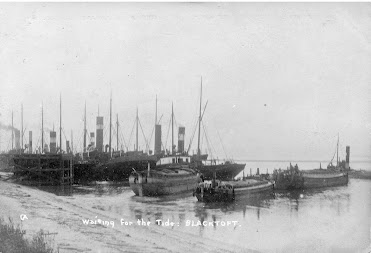
Blacktoft jetty


Blacktoft -  jetties and inns. 

After a query about a Blacktoft family who were piermasters I thought I would put together a summary of that bit of Blacktoft history. It has turned out a bit longer than I thought! Probably because where there are jetties there are often pubs so I have found out a bit about them too. Thanks to Robert Thompson of Blacktoft who has shared his musings on both topics.

Blacktoft as a riverside settlement has always been a place of mooring for vessels. There were originally three large staithes there (triangular stuctures which jutted out into the river) where boats could load and unload. One of these was Skyn staithe which was where the Hope and Anchor [now no longer a pub] is today although the pub was not built until the 1820s.

Blacktoft had also by the 1820s a public landing near the Bay Horse Inn which stood on the double bend in the village. This was where paddle steamers on their way to and from Hull and Goole called and where until the railway came where  coal for local villages was landed.There was a ferry from there too to Horseshoe Landing on the opposite side of the river Ouse. 

The first mention of an alehouse in Blacktoft was in 1627, when the Rev. Thomas Fisher was accused of “frequenting a Robinson’s house and a Thompson’s house, being alehouses in the parish of Blacktoft, and did play unlawful games”

A later ale house keeper probably of the Bay Horse was Richard Boase who is first mentioned as an ale house keeper in Blacktoft in 1754. He had to assure the magistrates,

 “That he was a peaceful, honest man, and a proper person to conduct a public house in Blacktoft, as is the necessity for the convenience of trade on the river and other just causes”

Other landlords came and went but then John Lister came to Blacktoft. He was born in 1766 at Rawcliffe and in 1790 married Frances Briggs in Howden when he was described as a husbandman. By 1798 he was in Blacktoft, owning a small amount of land. He had two daughters  Elizabeth and Mary but in 1806 Frances died. He remarried in 1808 Fanny Young from Crowle and by then he was described as an innkeeper. They had children John, Fanny and Thomas.

John Lister lived in Blacktoft almost 60 years until his death in 1855. During that time he was innkeeper, farmer and coal dealer.


This is the original Bay Horse inn sign, found many years later on the site

The Hope and Anchor

But in the later 1820s a rival inn was built in the village. This was the Hope and Anchor. It was built by 1829 when William Reynolds of Blacktoft, 'of the Hope and Anchor', married  Bessy Jacques, eldest daughter of Thomas Jacques of Bellasize.

Skyn staithe was renovated and became the ferry staithe.  Coal was delivered here until around 1880. And the area nearby became the village "shopping centre"!

William Reynolds left the inn and was living, a farmer, with his family at Gowthorpe where his wife died in February 1846.

The new landlord was William Shillito, originally from Selby. He did not stay long and in 1852 an advert appeared as follows.

Jan 1852

Blacktoft to  be let and entered upon on the Sixth of  April next, the Hope and Anchor, Public Housue together with grocer's shop, and any quantity of land not exceeding eighteen Acres, now occupied by Mr. William Shillito. For Particulars of rent, apply to John Schofield, of Faxfleet Hall,  or to Thomas Haldenbv,  Porter -Street, Hull.

Another similar advert appeared four years later

To be let at Blacktoft, and entered on the 6th of April, 1856, That well-known Public House, the Hope and Anchor with the Grocer's Shop, Butcher's Shop, Coal Shed, Stable, and Garden  and about 16 Acres of good land, chiefly Grass, now in the occupation of Mr. Richard Clegg.

But a big change was about to take place. The new landlord was a local man, George Taylor. and he was there when in 1874 the Aire and Calder Navigation company bought land at Blacktoft and built a jetty.

The Howdenshire Gazette reported in October 1874  that

Blacktoft. The Aire and Calder Navigation are progressing quickly with the pier, which is being erected here with the view of giving vessels coming up the river from Hull to Goole some place to moor against should they find it necessary to remain midway during low water. The pier is 180 feet long is being built very strongly, and the depth of water alongside will be sufficient for heavily laden vessels. It will be completed, it is expected, in a few weeks time. It will remove one of the objections which have been raised by shipowners to sending up their vessels to Goole, and the Aire and Calder Navigation  are  certainly entitled to the thanks of all interested in the port of Goole for what they done in this matter.

It took a little longer than a few weeks and a year later we read that,

October 1875

Blacktoft Pier, which has been built at the cost of the Aire and Calder Navigation, for the protection of ships bound to and from Goole, is now finished. The barque Ida, which arrived on Friday with a cargo of logwood from Jamaica, is said have been the first vessel making use of it. The weather interfered with her completing her voyage on Thursday evening, so she laid by the pier until the next morning

In 1881 the pier was lengthened  and was now 470 feet long by 22 feet wide.


The Blee family outside the Hope and Anchor. Thomas Blee was landlord by 1891.

Robert Powell

By 1891 there was a piermaster who lived in a house next to the jetty. This was Robert Powell. Robert Powell actually deserves an article on his own. He was born in Blacktoft,  and aged 18 in 1846 he enlisted in the Royal Artillery. He was a gunner. In 1850 in Montreal he married Leocadie Lefebvre who was from Quebec and they went on to have five children, born both in Canada and England. In 1867 he was discharged but while she and the children remained in Woolwich Robert came home to Blacktoft.

By 1881  he was living as a pensioner with Emily as his wife. She was 15 years younger than him and said she was born at Bielby near Pocklington on most censuses.  He was described as piermaster in 1891 and 1901 living in Jetty House. He died in 1905 and is buried at Blacktoft. Emily moved to York and died in 1927.

Leocadie meanwhile was living in London when she died in 1898. Her death certificate describes her as  the wife of Robert Powell, Piermaster of Blacktoft

The Howard family

Janet, a lady whose family have been connected to Blacktoft for many years recently sent me some information about her Howard family.

Her great grandfather was Joseph Howard. He was born c1839 in Gainsborough where his father Thomas was a boatmaster. Joseph settled in Hull, working as a riverman. In 1865 he married Mary Elizabeth Watkinson, giving his occupation and that of his father as mariner.

They had seven children including  Maria born 1866, Myra born 1867, William born in 1869, George born 1870, Herbert Tom born 1872 and Joseph born 1879.

At some point in the 1890s Joseph and Mary moved to Blacktoft where according to his sons' marriage certificates he was postmaster.

In 1897 son George, who described himself as a dentist, married Clara Collins at Blacktoft. Clara was born in Hever, Kent where her father was a small farmer but in the 1891 census she was working in a dentist's household in Burton on Trent. However they met is speculation - but thereafter the Collins family and the Howards were intertwined and connected to Blacktoft. 

A few months later in May 1898 William Howard married Edith Collins, Clara's sister at Blacktoft. 

And in 1906 Horace Bannister Collins, brother of Clara and Edith  married Myra Howard at Blacktoft. He was 36 and she was 39. Myra described her father as a gentleman and Horace too described himself as gentleman.


Horace Bannister Collins in the doorway of his shop next to the Hope and Anchor

In 1901 William is listed as grocer, shopkeeper and coal dealer whilst Edith his wife is listed as grocer. But after the death of Robert Powell William became piermaster and moved into Jetty House in 1907. William and Edith had four/five children, Beatrice Myra born 1899,  Eveline Edith born 1905,  Joseph William born 1906, [died aged 3 months] Marie born 1907 and Joseph born 1909.

Edith and William with left to right,  Eveline,  baby Joseph on Edith’s knee, Beatrice, Marie on William’s knee.

The family lived there until 1922 when William was killed in a tragic accident.  William was in a pony and trap driven by Philip Blee, the licensee of the  Hope and Anchor. They were returning home from North Cave and were near Newport. With them on the rear seat of the trap were Mr Blee’s married sister and her niece.  On the journey a lorry with a load of four tons of oranges and lemons, driven by nineteen year  old Vincent Bird of Barnsley collided with the trap, which  overturned, and Mr Howard was killed.

The trap had pulled to the side of the road to let the lorry pass but the overhang on the lorry had caught the trap. Mr Blee was knocked unconscious and sadly the lorry wheel ran over Mr Howard. There was a court case but the young driver was cleared of manslaughter.

The Howard family moved out of Jetty House but stayed in the village.  


Jetty House

Beatrice became a nurse and was living in Devon in 1939.

Eveline married Herbert Robinson, a merchant seaman from Goole in 1930. He was  awarded the MBE in 1944.  

The newspaper report tells us

Mr Robinson, who is a native of Goole, has followed the sea since leaving school, and during the last war was in ships carrying ammunition to France. After service with various Goole shipping companies he joined the Goole Steam Shipping Co. (Associated Humber Lines) in May, 1926. as second officer on the s.s. Saltmarshe, and was promoted to the rank of chief officer in 1937. 

He holds a foreign-going master's certificate. Mr Robinson was chief ,officer on the s.s. Rye (commanded by Capt. A. Hiley, who has also been awarded the M.BE.).when she sank an E-boat in a Channel convoy action ,and he has also been in many other incidents since the beginning of the war.  

He was later promoted captain and died in 1960

Eveline/ Evelyn was the headmistress of Blacktoft school and they lived in the schoolhouse there. Mrs Robinson is remembered as being quite strict.

Marie married Albert Bradley from Gilberdyke. He was a churchwarden and hay cutter and as a relief teacher Marie taught at both Laxton and Gilberdyke schools. They are Janet's parents.

Later Marie had  the first two semi detached houses built in Staddlethorpe Lane. Sunny Dene where Eric and Annie Reed lived and Meachlands where Janet's family lived until she sold it in 1957 to Eric Reed when Brian Reed with his wife Elva and children moved there.

Joseph went to Drax school and became a customs officer.


Two pictures showing how busy the jetty was


Later events

In 1939 the jetty master was Frank Schegel who had previously been berthing master on Goole docks. In 1940 his son, also Frank, married Enid Dickson of Staddlethorpe.

Frank snr left Blacktoft and the new pier master was Captain Dick Collier. There is a lovely account on Goole on the Web  written by Derek Collier of moving in. [There are many other memories of the village on the site]

On a wonderful and very sunny Saturday in July 1941, Captain Dick Collier and his wife, three daughters and two sons (Mary, Pauline, Dorothy, Dick and Derek) arrived to move into the pier house. The gardens at each side of the concrete path from the pier entrance down to the house were ablaze with large double red poppies with a rose arch half the length of the path. The house had mains water and a water toilet (only one in the village), also a bath room with hot water from the coal burning cooking range. No gas; no electric; at night we had paraffin lamps. The family of five children five years to thirteen years old started school on the Monday. Two classrooms, teachers, Mrs Taylor for under nines and Mrs Robinson for nine to fourteens.

There were many experiences, one being when a bomber crewed by Polish airmen crashed into the Trent one midnight. Sandy [Rowland] Winn a farmer of Faxfleet telephoned Capt. Collier and asked him to listen carefully as he put the phone out of his bedroom window, there were distant shouts of "help, please, please help". Capt. Collier agreed to meet Sandy at the drain on the Blacktoft to Faxfleet road where Sandy kept a very small boat with a very dubious inboard engine. They arrived along with Norman, son of farmer/milk man Parker and set off for the Trent training wall. They found about four airmen lying on the stones with the tide rising and lapping their legs. All got into the boat but, the engine failed. As they started to drift, a ship's masthead lights came into sight (from Hull). Capt. Collier signalled with his torch "persons stranded in Ouse", Fortunately the pilot was a wonderful personal friend (Tommy Mapplebeck from Goole). He manoeuvred the ship with tremendous difficulty until the boat was alongside and heaved it up on one of the ships life boat riggings. All ended well.

In 1950 Frank Raywood took up the post of jetty master, until his retirement in the 1980s.

A new jetty was built in 1956 which is still in use. There are lots of  old newspaper accounts of ships colliding with each other and with the jetty- too many to write here.

But I will conclude this rather long blog post with another memory from the Goole site.

I wish I had a £1 for every time we berthed at Blacktoft Jetty in the 1950s, usually because of fog. I remember the pub at the time was like sitting in a back kitchen - they had beer barrels on trestles. The skipper kept deck watches on but if we were off watch we went for a beer. I remember one night aboard the SS Alt, in a real peasouper of fog, hearing wild geese flying overhead, they must have collided with electric cables as suddenly it rained geese falling on deck. We collected them and Xmas came early - roast goose next day was on the menu. 

When I began this post I did not realise how much happened at Blacktoft - now I do!!


Wednesday, 7 May 2025

Laxton VE day

 This week we are celebrating VE day - Victory in Europe. The day was 8th May 1945, 80 years ago and there are a dwindling number of those who remember it.

I live near Laxton and thought I would look  briefly at those four  names who are on the war memorial board in the church there and find out a little about them if I could.

Lily Anson

She was born in 1913 and  was a member of a large family many of whose descendants live locally today.

Her father Joseph died in 1923 and a newspaper report comments

1923 By the death of Mr Joseph Anson Saltmarshe has lost a very highly respected and  widely known resident. Mr Anson who was 58 years of age spent the past 30 years at Saltmarshe 13 of which he was  in the employ of Mr PC Thompson. He leaves a widow, three sons and eight daughters. The funeral took place at St Peter's Laxton the Vicar the Rev W Sherwin officiating. Practically the whole village turned out to pay their tribute.

In 1939  Lily was working as a domestic servant in Howden. 

Lily was a corporal in the WAAF [ Womens Auxiliary Airforce] and died on 18th September  1945 aged 32. She was a cook and was admitted to Little Bromwich isolation hospital where she died of diptheria

She is buried at Laxton and the memorial stone is a war grave

Frances William Barker

Frances William Barker was the son of Edward and Gertrude Barker. His father was a woodman on the Saltmarshe estate.

He was born in  1924 and in 1939 was living in Woodside Cottage Laxton with his parents and brother Alan.

He was only 17, an apprentice, when he was lost aboard the SS Bullmouth, a merchant ship on a convoy.

On October 29, 1942, SS Bullmouth was sailing to the Tyne in ballast when she was torpedoed and damaged by U-409 and became a straggler. The position was about 100 miles NW of Madeira. She was then struck by a further two torpedoes from U-659 and sank. The chief officer and five crew members managed to reach the island of Bugio near Madeira but the master (John Wilfred Brougham), forty-four crew members and five unknown DEMS gunners were lost.  Forty three men are commemorated on Tower Hill, Panel 21 and two on the Canadian Merchant Seamen Halifax Memorial.

Sidney James Hobson

Sidney was born in 1918, the son of James and Ann Hobson.

In 1921 he was living at  High Metham with his parents and widowed uncle and cousins

In 1939 he was  living  on Front Street in Laxton with his parents and was a farmworker

In 1942 he married Lillian Hablett

He was a gunner in the Royal Artillery with a Heavy Anti Aircraft battery in Algeria.  He was killed on 7th January 1943

He is commemorated on the Medjez-el-bab memorial in Tunisia


Sidney is on the photo below, back right aged about 14.


Laxton school 1932
back from left: James Brown, Percy Laking, Harry ?lindley, Ernest Sweeting, Sidney Hobson
Middle::  Jean Thompson, Mildred Walker, Margaret Sweeting,  Mary Hardwick, ? Lindley, Joan Hardwick, Vera Barker, Phyllis Brignall.
Front :Ernest Brown, Jack Forth,  Robert Taylor, Ernest Sweeting, Maurice Thompson, Claude Brignall, Arthur Oakley,  Harry Brown.

Ernest Gordon Nicholson

Son of Ernest G. and Alice May Nicholson, of Laxton, Yorkshire.

In 1921 Ernest was 6 months old, born in Manchester and living with his parents in Hull where his father was an out of work fish dock worker.

In 1939 he was living with his mother Alice in Laxton

He was in the Royal Air Force Volunteer reserve an airctraftman 2nd class and was taken prisoner on 8 March 1942 when Java fell

In 1944 the Hull Mail reported   that a Tokyo message  re-broadcast by the German radio gives news of Ac.2 Ernest Nicholson. A.F., whose mother lives at Laxton, near Howden. 

  " Dear father, This is the first letter I have been able to write since becoming a prisoner of war which might possibly reach you. It will at least let you know I am still alive and able to inform you that we are being well treated. We are all anxiously waiting for the day of freedom to dawn. Give my fondest love to mother. Tell her not to worry. Soon we shall meet again. I am sure 

Unfortunately this was not to be as Ernest died of malaria on 8th May 1944 while on board  the Japanese vessel Ss Tencho Maru and was buried at sea

His name appears on the Singapore war memorial.

Looking again at where these Saltmarshe and Laxton men - and woman- served and died you cannot help but wonder at the contrast between their early lives in the Yorkshire countryside and where they lost their lives

I have not been able to find any reports or pictures about how Laxton  and Saltmarshe celebrated VE day  in 1945 but wonder how many of the children in the 1932 picture served in the forces and came home safely. Any comments and/ or pictures would be very welcome.

This however is a description of what happened in Howden

May 8th  the BBC announced, would be celebrated as Victory in Europe Day. Howden had made its celebration plans the previous Friday when ‘the Bellman’ – a local version of the Town Crier – had gone round calling people to a meeting at which a celebrations committee was formed. 

VE Day began with a swift transformation of Howden’s streets as flags and bunting appeared from all corners. Many shops remained closed. At shops which opened flags and other celebratory paraphernalia were quickly sold out. A large union jack flew from the church tower, and in the afternoon the bells pealed for an hour. Hotels were granted an evening extension; the British Legion held a victory whist drive; on the Marsh crowds gathered around a huge bonfire. The following afternoon sports preceded a children’s tea in the Assembly Hall. Then a dance at the Shire Hall drew a large crowd and with the music relayed to the Market Place there was more dancing there until well after midnight.


Monday, 21 April 2025

Saltmarshe and Hook

 It's Easter Saturday  and  I'm going out to lunch to celebrate a friend's birthday. Tomorrow we are having the traditional roast lamb and will no doubt be eating chocolate!

In the garden it is that difficult time when the snowdrops - we have a lot-  are dying back but if we want a display next year we cannot cut them. The same with the daffodils. But in the meantime it is interesting to see what flowers are emerging - red campion, honesty, cowslips, forget me nots and this year a lot of violets. I have planted rainbow chard, broad beans, snowball turnips and cabbage so far in the raised bed but although the chickens are confined there are a lot of pigeons about. So all is netted.

I have been to two concerts recently - the first was in Cowick church where the Snaith choral society performed Mendelsson's  Hymn of Praise and Amy was the accompanist. It was very enjoyable although I understand musically challenging. [ I am not a musician!]


Snaith Choral Society, pictured in the Goole Times. Amy behind the keyboard!

Then I went to the first concert of the Howdenshire Music season in the Minster. It was a great opener- a full house to hear pianist Lewis Kingsley Peart perform  a very varied programme.

I have been looking at the histories of two different families. The first was very local and lived at Saltmarshe. Thomas Barker was  a shoemaker [or cordwainer] and was also the landlord of the Punchbowl  in the village in the early nineteenth century

I cannot find records so far of any earlier inn in the village and after Thomas left the village in the late 1820s [not sure whether he moved or died but cannot find a death record] the name disappeared and thereafter the village inn was The Plough.

Thomas married firstly in 1794 Sarah Parkin at Whitgift. Their son  Richard was born the following year and baptised at Laxton. A daughter Mary was baptised at Laxton but both mother and daughter died within a few days and were buried at Whitgift in 1797.

Thomas remarried in 1801 to Hannah Jewitt and their daughter Mary Jewitt Barker was baptised in 1803.  Hannah born c1862 died in 1821 and was buried at Laxton.

Thomas married for a third time to Ann Easby in 1827 at Howden. He was described as a shoemaker. Their daughter Jane was baptised at Laxton in 1829. Thomas was then described as a publican.

Thomas is listed as running the Punchbowl in records in the mid 1820s when a publican had to have an alehouse licence and someone to stand surety for him.  In 1826 this was John Fitch, draper of Howden. The Fitch family were prominent in Howden's history throughout the 19th and 20th centuries and ran a drapers' shop in Market Place. In 1823 Thomas' son Richard had married John's sister Hannah.

Richard was then living at Knaresborough, a wine merchant. He lived most of his married life at Bourne in Lincolnshire where he ran a wine and spirit business but was buried at Knaresborough in 1875. Hannah had died the previous year and is buried in Bourne.

 
Saltmarshe villagers outside The Plough in  the early twentieth century

The second family I have been looking at is the Calvert family of Hook. The Howdenshire Archaeological Society in connection with the 800 year celebrations of Hook church is looking at the stories of those buried in the churchyard.

I was asked if I knew anything about a Judith Watson whose stone tells us that she was buried in 1793 aged 60. I looked up what I could find about her and - like much family history- this led me on quite a trail. Judith married John Watson at Snaith in 1778. She was a widow, he a farmer.

Her first husband was William Calvert who died in 1777 and whom she had married at Hook in 1760. Her maiden name was England/Ingland. I thought the Calvert name seemed familiar and indeed it was. William and Judith were the parents of a son William born in 1767.

In the book Methodism in Marshland George West says that William Calvert was the leader of the Hook Methodists and lived on a small farm called 'Monica'. I believe too that he was the builder of what we now know as Heron's Mill on Hook Road.

I found this sale notice in the newspapers

Dec 1826

CAPITAL Brick CORN WIND-MILL and TWO DWELLING-HOUSES, at Hook, adjoining the New Town of Goole

 To be SOLD by AUCTION, at the House of Mr. Wm. Wells, at Booth Ferry, in the County of York, on TUESDAY the 19th Day of December instant, at Three in the Afternoon, 


Lot 1.all that very valuable Freehold and newly- erected Brick CORN WIND-MILL (being five stories high and having two Pair of French Stones, one Pair of Grey Stones, and a Corn Screen, and turning and striking its own Cloths), with all the Gears, Machinery, Utensils, and Appurtenances belonging thereto, situate and being in the Township of Hook, on the Borders of the new and improving Town of Goole, in the said County of York. 

And also, all that suitable and newly-erected MESSUAGE or DWELLING-HOUSE, Outbuildings, and Garden, and a very fine Orchard (newly planted and in a very flourishing state) adjoining and belonging to-the said Mill containing about Three Roods, in the occupation of Mr. William Calvert, the Owner. 

N. B. The above Premises, arc on the Southern Bank of tbe River Ouse, when Steam Packets daily pass to and from Selby, Thorne. Hull etc., and will be found a very eligible situation. 


Lot 2 . All that other valuable Freehold MESSUAGE or DWELLING-HOUSE, Barn. Stables. and Outbuidings, situate and being in the Town of Hook aforesaid, adjoining the Methodist Chapel, also having an excellent Garden and Orchard liebind the same, containing about three roods, now occupied by Mrs. Hannah Marshall. 

Mr. Calvert and Mrs. Marshall will show their respective Lots ; and further Particulars may be bad on  application at Redness, or (any Saturday at the Half , Moon Inn) Howden, at the Offices of THOS. H. CAPES, Solicitor. Redness, Dec. 4. 1826


In 1796 William Calvert had married Ann Marshall at Whitgift. They had family, including  a son Marshall born 1799  and William born 1805


Marshall died in 1823 and is buried at Hook. 


William married Mary Cooke at Selby in 1838.  They lived and farmed at Langrick near Drax. Their son, another William became a Methodist minister.


William and Ann, who had been living near their son, died in the their 80s within three weeks of each other and were buried at Hook in 1849.


I know that an Alfred Calvert founded the Ouse Shipbuilding yard at Hook during the First World War but having checked there is no connection between the two families.


On a sad note I would also like here to mention the death of a good friend Ken Deacon of Howden who died recently. I first met Ken and his wife Anne when I was running a local history class in the town. 

Ken had been in the RAF and had moved to Howden to be near his wife's family. After a few years working at Brough for British Aerospace Ken retired. He became fascinated by the local airship connections in particular the R100 built at Howden


 Ken Deacon, an enthusiastic purveyor of Howden's history

Thereafter he researched, wrote books, gave talks, put on exhibitions and this culminated in the installation of the R100 airship trail though Market Place in Howden. Ken  was very knowledgable, enthusiastic and did a lot for Howden. RIP Ken. His funeral is in the Minster on 28th April at 11am