Showing posts with label Saltmarshe. Show all posts

Tuesday, 5 August 2014

Saltmarshe history and museum


Today has been a lovely day as friends, many from my history classes joined with neighbours  to help us celebrate the opening of our small museum.

What began as a project to renovate a neglected cottage in my garden has turned into the creation of a small local history museum. Members of the Goole local history group -  but mainly Gilbert Tawn - have plastered, painted and hammered until we have a home for the many interesting objects which we either collected ourselves or have had loaned and given.

Gilbert  opening the museum

The rain held off and we watched a slide show of the transformation before around 50 people watched Gilbert cut the ribbon and then were able to look around. It is an ongoing project with a mix of domestic bygones, displays of woodworking tools, old radios, bits of the  airship R100 [very very small] and old toys. There are also old photographs and a considerable amount of  information about the history of Saltmarshe and the surrounding area.

Although not intrinsically valuable the artefacts, we hope, will evoke memories of schooldays, baking, washing and farming as well as everyday life. We also have a collection of local bricks and drainpipes.

We drank many cups of tea and ate lovely cakes baked by Gilbert's wife Gloria. The sun shone and everyone wandered round and talked. A very good way to spend a summer afternoon.

The museum will now be open for groups and individuals to look round - but by prior arrangement only.  It is near both Saltmarshe Hall and the  Saltmarshe holiday cottages and I am happy, with my local historian and professional genealogist's hat on, to help any one who needs to know more of their family history or obtain an old photograph of the area.

Contact me if you are interested in visiting.

Vistors looking at the display


Inside the 18th century kitchen
The 'parlour' with its original curved top display cupboard


Brenda, Eileen and Goff

Tuesday, 9 July 2013

Saltmarshe Hall visit

Since my last blog post I have been on holiday and returned to a garden which looked more like a field.  The grass had grown amazingly and the grasscutter would only chug through it very slowly. As for the vegetables they are temporarily lost in a sea of sow thistle, chickweed and goosegrass. But when I look carefully I think they are growing well.

Molly has been in kennels for the first time and did not like it.  It took her three days to wag her tail properly and accept that she was safely home with her friend Poppy the cat.

Last week I took a group of students and friends to Saltmarshe Hall for a visit. The new owners, the Whyte family, have been there around a year now and were very welcoming.

We were able to look around the formal rooms, dining room, drawing room and library, all accessed off the magnificent hallway with its cantilevered staircase. We then were able to explore part of the former servants' wing and the cellars and the beautiful gardens.

If I am honest I think that the most popular part of the visit was when we looked at the servants' bedrooms, left as they had been probably 60 years ago with the original wallpaper and bedsteads. Maybe it was because most of us felt that our ancestors would have been servants rather than part of the much richer family who lived 'upstairs'.  Shades of Gosford Park perhaps?

Tonight I have tried to deal with two wasps' nests, one in the roof of  the part of the house where I am sitting now typing and one a only few feet away from  the house and near our picnic table. I have sprayed them with a foam bought from our local diy store and await the morning to see whether it has worked.

This bedstead is in the former servants' wing at Saltmarshe Hall

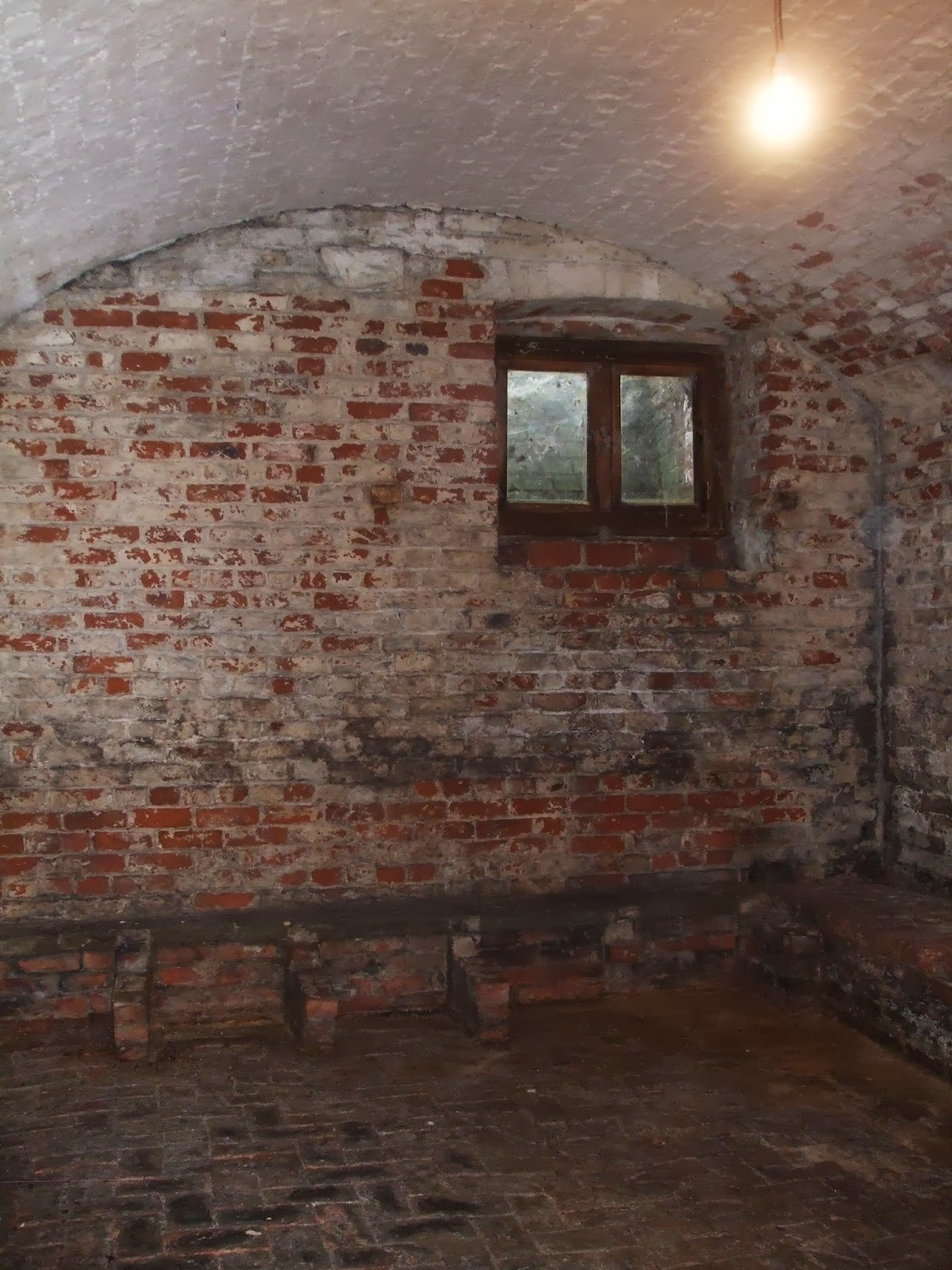
This view shows one of the several cellars on which the hall is built.

Sunday, 20 January 2013

Winter weather

I am busy with several history projects at the moment. With my Goole WEA class we are looking at the early history of Hook as well as trying to find out more about Ousefleet Hall, which was locally often known as Empson Hall.

I am also researching the history of Saltmarshe - the family and the village. The family claimed ancestry back to the Norman conquest although sadly when Philip Saltmarshe died in November 1970 he was the last of the male line. I am talking about Saltmarshe at both the Boothferry group meeting on January 28th and the Marshland History group on January 29th. I had agreed some time ago to speak at both groups but had not realised the meetings were on consecutive nights.

But life is not all history projects and the present spell of wintry weather has produced some interesting travelling conditions as well as some stunning winter landscapes. We are finding too that the house is cold even though the Rayburn and oil boiler are both going. I think it is the wind which whistles around the walls of what is partly an uninsulated old house which makes the difference.


Above are some pictures from last week of the sheep in Saltmarshe Park. It was a grey day with snow flurries when we took the pictures. I like the skeletal shapes of the trees in the background.


Monday, 11 June 2012

Howdenshire History

We have been thinking for some time that my Howdenshire History website needed an overhaul. One of the main problems was that it did not have a proper address and so this weekend after many hours labour we have moved. The new address is:

www.howdenshirehistory.co.uk

Further updates are planned and I am hoping to add some new content including more photos and a page on Saltmarshe history.

I have just watched the Wheldale going past on its way home to Goole after taking part in the Jubilee Pageant on the Thames. I expect the crew are exhausted - last week's weather held up their return and it is still very cold and grey - but congratulations to them in bringing  Goole and its history to the forefront of the national and international consciousness.

I have recently been reading my copy of the bound files of the Goole and Marshland Gazette (covering Goole and Howden area history from 1854 until the late 1860s). It appeared monthly and is  is a fantastic resource for the history of this part of Yorkshire. The whole volume is very fragile but I have experimented by copying an extract  using a hand-held scanner. Here is an extract from the edition of January 1862 (please click to view a larger version).


Friday, 27 April 2012

Trip on the Sobriety


Last Friday I went on a trip on the Sobriety with 12 members of my Goole WEA class from the Waterways museum at Goole. Sobriety is a Humber keel, built in 1910 and now fitted out for day and residential trips either along the canal system or on the river.

The trip was organised by Eileen Sherburn who, with her husband Goff, is  a member of   the class. Goff has spent his working life on such vessels and, as their son Chris, along with Waterways manager Rachel Walker, were our crew, we were in safe hands.

Although it was cold and sometimes wet it was fascinating to see Goole and the local villages  of Swinefleet, Saltmarshe, Blacktoft and Whitgift from the river. We journeyed past Hull up to Paull as we were travelling with the tide which was flowing quickly. The trip took us all day and we returned to Goole around half past six in the evening, passing through Ocean Lock on our way back to the museum.

Below are some pictures of our trip taken by Gilbert Tawn, our resident photographer!


Sobriety at the Waterways museum

Leaving Goole

Passing Saltmarshe

Whitgift church

Yokefleet windmill

Gilbert

Passing under the Humber Bridge

Hull

Almost home

St John's church, Goole

Thursday, 16 February 2012

Holiday cottages at Saltmarshe near Howden

Last night I was the speaker at the Laxton WI and had a very enjoyable time. The meeting was thrown open to any interested villagers and around 50 attended. I had gathered together around 150 old pictures of Laxton, Saltmarshe, Sandhall and Skelton and put them together into a Powerpoint presentation.

There was a mixture of scenery and familiar faces but of course the most popular were the old school pictures. The noise rose to a crescendo as those who were infants in 1955 saw themselves in short trousers or corduroy pinafores.

Afterwards we all ate butterfly buns and fruit loaf and cheese [the latter a traditional Yorkshire pairing]  and drank cups of tea.

I was talking to my neighbour who has two holiday cottages and provides bed and breakfast on the family farm. In fact she was a few minutes late as she was settling in some guests.

I met some  of her American guests last year who combined a UK holiday with researching their family history. It is only a short walk along the riverbank to where I live and I was able to find them some information on their family from my resources as well as suggesting what they should look for in the archives at Beverley and York.

I have added a link to Appletree Cottages and can recommend them to anyone wanting a peaceful break with stunning views of the River Ouse.

Here is a picture of the village shop in Front Street, Laxton which I showed last night.

Sunday, 8 January 2012

Laxton history

I have been looking at the history of Laxton [Yorkshire] in preparation for giving a talk to the local WI in February. On the internet it is often confused with Laxton in Nottinghamshire where strip farming survives.

Our Laxton is agricultural but the fields are large and arable and very flat. Until the death of the last Philip Saltmarshe of nearby Saltmarshe much of the village was owned by the Saltmarshe estate and still within living memory villagers had to tip their hat to the 'squire'.

The village has a church, a village hall [the Victory Hall], a pub and a garage but no longer has a shop and post office and sadly too there is no longer the village blacksmith.

Herbert Martin was the last smith and I can remember him shoeing a horse in the road. He also made gates, weather vanes and other ornamental ironwork as well as repairing farm machinery.

His blacksmith's shop, outside which there was often a gathering  of men, putting the world to rights, now stands empty.

Wednesday, 9 November 2011

More about the SS Aire at Saltmarshe

I was pleased to see Fiona's comment about my previous blog entry describing how she remembered the SS Aire at Saltmarshe. I thought it might be interesting to upload a couple of the pictures - I would be happy to upload others or any information which anyone would like to share.


Tuesday, 8 November 2011

Saltmarshe - the SS Aire

Today has been a typical dull, drizzly November day. I had hoped to take some pictures in Saltmarshe Park but the light was too poor.

I have recently been looking at photos of when the SS Aire was run aground at Saltmarshe after colliding with the German collier Helene B. Schupp on October 6th 1958. The pictures show the workmen in the park with winches as they tried to recover the ship and stop her breaking her back. It was to no avail and she was eventually destroyed. 


It is still possible to see the marks of the hawsers on one of the oak trees and there are markers on the river bank to show where the ship was aground.


In the garden there are still lots of apples - but everyone around has lots too so it is hard even to give them away. I am hoping to pick up some russets soon as they improve with keeping.


Molly the labrador is now more a small dog than a puppy although she still does not like the dark and chews almost anything she can find. She enjoys pieces of coal from the scuttle and can reduce a piece of stick to chippings in a matter of minutes.

Friday, 3 June 2011

Joseph Rank family history

I had an interesting visit this week from a descendant of Joseph Rank, the miller. The gentleman and his wife were tracing Joseph's Yorkshire roots and visiting places where there was a family connection.

Joseph was born on Holderness Road in Hull in 1854. His father was James Rank who had married Mary Ann Parrott in Hull in 1851.

However, the reason that my visitors were in this particular area of East Yorkshire was that Mary Ann was born at Saltmarshe in 1825, the daughter of Joseph and Mary Ann Parrott. She was christened at Laxton and came from a long-established Saltmarshe family who were sailors and boatbuilders.

By 1841 the family had moved into Hull, where Joseph continued to build boats and sail them and where young Mary Ann eventually met James Rank. Sadly, Mary Ann Rank died in 1858, having never recovered from the birth of her fourth child. Joseph, although only four when his mother died, apparently had very clear memories of her.

Another local connection is that Joseph Rank later attended a small private school at Swinefleet run by Rev Edward Cragg Haynes, believed to be Yorkshire's first black vicar. I was able to show my visitors a  photograph of Rev Cragg Haynes with some of his pupils and they tentatively identified one little boy as Joseph.

I find family history and the connections it throws up, such as this, endlessly fascinating.

Saturday, 28 May 2011

Emigration from East Yorkshire to Ontario

This week I had a visit from John and Sue from the US who were staying in Saltmarshe whilst tracing their family history.

Sue's great great grandfather Thomas Tomlinson had emigrated from Saltmarshe near Howden in 1826, sailing from Hull like so many other young men and making a new life for himself in Ontario.  They were hoping to find a record of Thomas' birth and although the date was not exactly right I think we found his baptism in the Howden parish records in 1803.

Sue is lucky as her great grandfather, Richard Tomlinson, wrote out an account of his ancestry which gave her some clues - and maybe a few red herrings - to follow up. She has given me permission to reproduce a little of the information here.


            Richard H. Tomlinson,  a history of his life

I believe it to be the duty of every head of a family, no matter what his station in life may be, to leave behind him some sort of a history of his life and doings not necessarily for publication but for the purpose of saving trouble and perhaps expense.  Altho I have no diary or record of my own life and so far as I am aware none of the family have kept any I am the more desirous that my children shall have all the facts before them imperfect as those facts may be and (was?) able as I am at this time to place them on record.


Parentage

My father was an English immigrant coming to this country about the year 1826.  I am unable to give the name of the vessel but I have heard him say it was by a sailer and that it took them about 13 weeks to cross from Hull to Montreal. 
There being no canals at that time the journey from Montreal had to be made in Durham Boats, a sort of scow, in which the goods were placed and the passengers were obliged to assist in propelling up the rapids.  However, they reached their destination – Port Hope – Smiths Creek as it was then called – in due time and they at once proceeded to transfer their luggage to row boats in waiting, to the shore.
  My father came from a place called Saltmarsh near Howden in the East Riding of York.  The estate belonged I believe to Sir Titus Salt.  At all events my father was born and brought up as a farmer upon the estate and until he migrated to America was not off it.
  Coming as he did at that early date he brought little with him and so far as I am aware there is but little left of what he did bring.  A few books, amongst them a Prayer Book of the Episcopal church to which to which he belongs and some other books all of which have disappeared or are in possession of my sister Lizzie now Mrs. Albert Webster of Oshawa except a box which he brought with him now in our farm at Howden Holm.   I would like very much that this box be preserved it must be nearly 100 years old and the only article in our possession that Father brought with him from England. 
Saltmarsh is beautifully situated on the right hand or west side of the river Ouse a tributary or branch of the Humber about 4 miles from Howden and about 8 or 10 miles from Goole, the head of navigation in a beautiful farming or agricultural country.  There is also a church and grave yard, in which latter many of my ancestors lie. 


My mother

 Soon after landing at Port Hope or Smiths Creek as it was called, my father proceeded to Bletchers Corners, a considerable town in those days, where he got employment and met my mother Miss Gitty Gosling (daughter?) of John Gosling who came from Dutchess Co., who was a seamstress and worked for a Mr. Walton a tailor in Port Hope.
 From here they were married and went to Rochester NY by a sailing vessel.  Upon their return, they went to live on the Ashford farm about 2 miles east of Bletchers Corners.  I think it must have been Mr. Olney Ashford’s father, he of Hawaiian notoriety, be that as it may here on this farm, me and my oldest brother were born,  I understand, and we lived there for a year or two, perhaps longer I cannot say just how long.
 The Ashford farm was in the Township of Hamilton but Port Hope and Cobourg were the principal market towns.  Bletchers Corners however continued to be quite a busy place.  I have often heard my father speak of  Esq. Sowden(?) and I am inclined to think that he must have worked for the Squire when he came to this country or soon after it.


I found it fascinating to talk to John and Sue as my own relative, Robert Nurse from Eastrington, emigrated to Port Hope, as did other Eastrington families including the Bletchers and the Ainleys. I am sure they must all have known each other.

Monday, 16 May 2011

Emigration from East Yorkshire

One of my particular interests is in families from this area of Yorkshire who emigrated to US and Canada in the nineteenth century. Now thanks to the internet their descendants can find their roots and some come and visit.

Although, having said that, I have a wonderful collection of letters [only copies] which chronicle the story of the Thompson/Medd and other Eastrington families who emigrated to the Port Hope area of Canada in the 1820s/30s. The families kept in touch very regularly.

Recently I have been contacted by descendants of Thomas Tomlinson of Saltmarshe near Howden. He left in 1826 but never forgot his roots and passed on to his family details of where he came from. Now his descendants are coming from Canada to see where he lived.