Saturday, 12 March 2022

Howden education, Howdendyke and Hook Road

 Since my last post a lot has happened in the world. Covid seems to be something we are all learning to live with and instead we are all now watching the awful events in Ukraine. Not only is it a tragedy for all those being bombed and displaced but it is having a dramatic effect already here at home. I am gathering fallen branches ready for the woodburner as domestic heating oil prices have tripled and we don't have any gas out here in what The Times in an article called 'a remote community'.

More mundanely the garlic is doing well and we have put an upturned black dustbin over the rhubarb although not much is happening in there yet.

I have been preparing a presentation on education in Howden  beginning with the Grammar school in the church and coming up to the present schools. The Howden senior school badge incorporates the original grammar school badge which in turn was the coat of arms of Walter Skirlaw, as well as referencing the horse fair, the market cross and Howden's connections with the bishop of Durham. It was designed by teacher and organist Ted Stockdale.

Earlier this week a friend and I walked around Howdendyke in preparation for a talk about the village at our small Skelton history group. So much of the village was demolished in order to make way for the fertiliser works to expand and it is difficult to work out where many of the old pictures we have were taken.

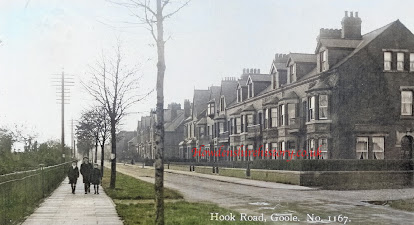
Meanwhile the other group I attend in Goole has spent several weeks moving slowly along Hook Road looking at the houses in a sort of version of a 'house through time'. Using newspaper and census records as well as pictures [ thanks to Gilbert Tawn who has photographed them all] we have looked at the dates and names of the houses and tried where we can to trace where their names were from and who lived in them.

We have also talked of Christ Church and its ministers, possibly also  the  site of an early Goole Grammar school, of Richard Cooper's original Phoenix iron foundry, a Palace of Varieties and Herons' mill.

This week we looked at Nunraw, so called as in 1923 it became the home of the Milner family. The family of course still has the florists' shop  in Boothferry Road. An early Mrs Milner came from Nunraw in Scotland.

Let us hope that by the time  I write my next blog post  there will be peace in the Ukraine.


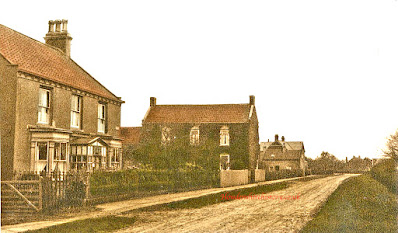
 A very rural view of Goole's Hook Road


Saturday, 19 February 2022

Snowdrops and Sandhall

I am sitting at the computer looking at the garden trees swaying gently in the wind. I think that Storm Eunice concentrated her fury in the south and let us off lightly. Although sometimes I wonder whether it is best not to follow these dramatic warnings and just wait for the weather to do its thing - as our forefathers did.

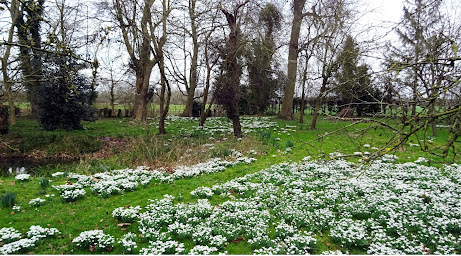
Our snowdrops have put on an excellent show this year and have spread even further than last year.  The hellebores are not quite in flower and neither are the daffodils. But I have been buying seeds and am looking forward to getting some tomatoes started on the windowsill.


It has been busy too on the history front. I have been looking at a family who emigrated from East Yorkshire to South Africa in the latter half of the nineteenth century. The branch I have been looking at were a couple who married in 1890 in Howden church. William Buttle Turner who was from Allerthorpe and Caroline 'Carrie' Hart went to live in an area near Camperdown where extended family already lived.

Caroline was the daughter of Anelay Hart who was the farm bailiff and later a tenant of  the home farm at Sandhall near Howden. The Scholfield family who owned the Sandhall estate  were prominent in the life of Howdenshire and were great benefactors to the area.  For example the aptly named Scholfield memorial hall in Skelton was built for the community as a school and church combined.

Two of the magnificent Capronnier windows in the west front of Howden Minster are dedicated to members of the family. The central window is  dedicated to William and Ann Scholfield

To the glory of God this window is dedicated. It also bears witness to the love and gratitude of the eight surviving children of William and Ann Scholfield of Sandhall whose married life lasted more than fifty seven years. William Scholfield born February 28 1774. Died August 8 1854 and his wife born June 27 1773. Died August 18 1856. They are buried in the Chapter House of this church.

 The right hand window is dedicated to their son Robert.  Underneath the script reads

 To the glory of God and in affectionate remembrance of Robert Scholfield esq of Sandhall in this parish. This window is erected by his sorrowing friends and neighbours. He died January 11th 1868 aged 64 years


 The Capronnier window dedicated to Robert Scholfield.


There is also another magnificent window in Doncaster Minster dedicated to Robert's brother Dr Edward Scholfield. 

In complete contrast to this the history group I attend in Goole has been looking at the development of Hook Road in the town, most of which was built in the late nineteenth century and occupied by seafarers and their families and the professional classes. It is our eventual intention to write the material up  and make it  freely available. We are particularly interested in trying to find out where some of the house names originated.


Saturday, 22 January 2022

Hook chapels

 We are in a run of sunny, frosty weather, perfect for dog walking but not so good for the oil tank which will soon need re-filling. But we are seeing signs of spring. The snowdrops - and we have a lot - are just beginning to show white and the daffodil spikes are getting taller.

 I have been busy loading pictures into my new website [ not yet online] and also looking at a family history which has been very interesting as the people all lived locally and it  is easier to envisage their lives when I know the area. There is a lot can be found online about families, particularly on the old newspaper sites but nothing can beat  being familiar with the towns and villages mentioned.

Last week  the small  local history group I attend in Goole met again after the Christmas break. We meet on a Thursday morning in the Oddfellows hall and talk about the history of Goole and the surrounding area. Some of us have been researching for many years and continue to do so, others just come to listen and join in the discussions and we have new members who have not long lived in the area. It is surprising what a wealth of knowledge there is around the table.

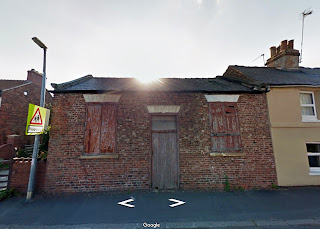
This week we were talking about Hook and its chapel[s]. One of our group had noticed this building which we thought was surely a former chapel. It looks like so many local chapels


 Hook


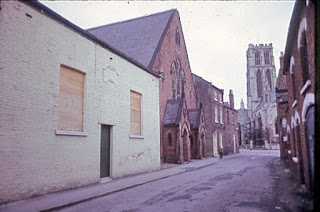
 Howden St John St


So we are seeing what we can find out. We have consulted the Hook history book which told us that the 'new' chapel was built in 1874/5.

The Goole and Marshland Weekly Times, Friday, 22nd Jan 1875 reports its opening

OPENING OF THE NEW WESLEYAN CHAPEL AT HOOK
The first Wesleyan chapel built at Hook was erected in 1816, the second in 1836, and now 1875 has seen the opening of a third place of worship, rendered necessary in the first place by the increasing congregation and in the next by the want of suitable accommodation for the Sunday school.
Mr James Armitage offered a piece of land at the corner of the roads which meet nearly in the centre of the village, and funds being forthcoming it was decided to build at once. Mr Bairstow, of Selby, was the architect, Mr Elliott and Mr Appleyard, of Goole, the contractors, while the foundation stone was laid at Whitsuntide by Mr W. Dyson, of York.  

I am sure we shall find out more  but would be interested in any further information or pictures. We believe that the old chapel building was used as a Sunday school but for how long? And anyone who wants to join us on Thursday mornings would be most welcome.


Thursday, 6 January 2022

Release of the 1921 census

 As I write this it is frosty outside and the car windscreen is frozen.This is in contrast to the very warm weather we had over Christmas - which made it easy to keep the windows open when visitors came as we are still in the grip of Covid. I am hoping that when I read back over these blog posts in future months we shall remember this time but be socialising normally without taking tests before we go out. 

I received some lovely Christmas presents and have plenty to read but the tree is now out and the decorations back in their boxes. 

So now it is 2022 and as a family historian I am looking forward to exploring the 1921 census which has been released today on Find my Past. Only problem is that you cannot get a transcript or original image without paying, even  if you have a subscription. But you can search for free and when I searched for my mother, Joan Nurse b 1918 in Eastrington I could see she was there and it told me that also on the page were Robert and Elsie, her parents. It correctly identified the Howden area where she was but said she was in Eastington in Gloucestershire. So a few teething problems!


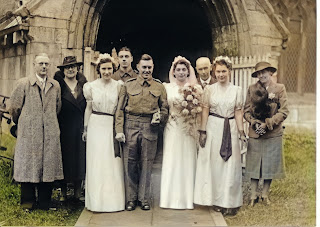
 80 years ago, January 1st 1942 Joan Nurse married Douglas Watson at Eastrington church. Soon after he was sent to serve in North Africa where he remained for three years. After his return  my parents  remained in Eastrington for the rest of their lives and taught many generations of children at Howden and Eastrington schools.


After the popularity of the newspaper snippets in my last blog post here are a few more - this time from 1922

April 1922

For sale— Argyll (15 9) 2 seater  car, sporting type JJ body, 1914 model, sleeve vale engine, CAV. lighting, Autovac petrol feed. Very smooth and silent; £250— J. Mortimer, The Gables, Eastrington.

For sale —Ford Car, 5-seater, 1920, fully licensed and insured;  in splendid condition; £135. Any trial examination.—J Mortimer, The Gables, Eastrington.


 Station Road Eastrington from a colour postcard.
The Gables can just be seen in the background on the left.

James Edward Mortimer was an entrepreneur born in Cleckheaton who built The Gables, then bought and moved to Knedlington manor and then finally to Howden hall where he died in 1946.

July 1922 Hull Daily Mail

Hull market .There was a great glut of mushrooms  today  in the Shambles and shops, Mrs Lilley, of Eastrington, bringing in 1,000 lbs, which sold from 6d to ls per lb.

Aug 1922

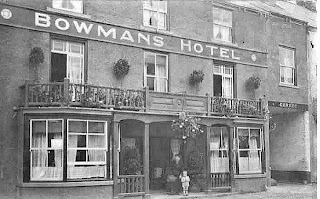
HOWDEN. OBITUARY.—The remains of the late Arthur Britton, who for the past seven years had been proprietor of the Bowman's Hotel, were interred in the churchyard Saturday afternoon, the Rev A. Waring officiating. The chief mourners were:—Mrs Britton (widow), Mrs Angus, Mrs Oakes, Miss Gladys Britton, and Miss Kathleen Britton (daughters), Mr and Mrs Hargreaves (uncle and aunt), Mrs Wraight, Mr W. Ayland, Major, Mrs Cockroft and Mrs H. Cockroft. Floral tributes were sent by the widow and family, and Mrs Hargreaves, Mrs Wraight, and Mrs G. Moore, Mr and Mrs Blakey, Miss A. Newman, Miss N. Dealtry, Mr and Mrs J. Good, and Mrs B. Shaw, and the Howden Licensed Victuallers'Assoc. The deceased gentleman's dog followed the coffin to the Parish Church, and remained in tho building during the service, afterwards accompanying the funeral party  to the graveside, where it stood and gazed down at the coffin. 


Aug 1922

HOWDEN. OCTOGENARIAN'S DEATH:- The death of Mrs Jane Laughton has removed one of Howden's oldest residents. Deceased, who was the widow of the late Mr George Laughton, blacksmith, was 80 years of age, and was born in the same house in Flatgate in which she died. The funeral, which took place on Monday afternoon, was conducted by.the Rev Kellett (curate)

Nov 1922

 A remarkable story of life-saving by telephone. While travelling from Selby to Howden on the L. and N.W. express on Saturday, two business men, Messrs Croft and Usher, looking out ot the window near Wressle, saw field alongside the line a bull, apparently its knees, attacking with its horns a young hoy, who was lying on the ground. I did not know whether to pull the communication cord or not," said Usher to a newspaper representative afterwards, but both Mr Croft and he instantly got out notebooks and scribbled notes follows "Bull killing boy in behind Wressle Station.' and threw these notes out as we passed level crossings. Arriving at Howden, Croft raced to the signal-box. The signalman quickly notified Wressle Station by 'phone, and the staff raced to the rescue. The child's life was saved, though he was badly mauled  by the bull. He is the nine-year-old son of a  farmer named Wood. 

Saturday, 18 December 2021

Christmas news through the years.

 
Laxton in the snow

The news is depressing, the weather is murky and the days are short so it is definitely time to turn to local history. 

I love looking at the old newspaper site  to which I subscribe and usually distract myself with reading all sorts of snippets. Sometimes it is something which has been mentioned on a facebook page like the fascinating story of the de Cobain family who came to Goole from Northern Ireland. One branch of the family lived in a house called Armaghbreague on Hook Road and a search on that name and Goole soon brought up lots of articles.

But  today I thought I would  look at what was happening in the local area at this time of year. What was affecting people then? So below is a random collection of  events from Christmases past. I was particularly interested in the reference to a Christmas tree in Howden, obviously then something unusual. 

I hope that next year we will all be too busy celebrating with our friends to have time to sit in front of the computer!!!

1859

HOWDEN. Christmas Treat. —On Christmas Day the inmates of the Howden Union Workhouse were regaled with the good old English cheer of roast beef and plum pudding to their hearts’ content, being allowed to eat much they liked. The provisions were of the first order, and were served up in style highly creditable by Mr. and Mrs. Meadley, the esteemed master and mistress of the house.


1869


HOWDEN  Christmas Tree,—On Wednesday  a Christmas tree was exhibited, and a sale of useful and fancy articles held the Town-hall, Howden. The proceeds will be devoted to  defraying the expenses of general cleaning of Howden church. The committee of ladies who originated the bazaar have worked in the most indefatigable manner to ensure the success of their undertaking and the results have exceeded the expectations of the most sanguine promoters. In spite of the inclement weather the Town-hall was crowded during the whole of the afternoon and evening, and the day's receipts amounted about £1OO, great many articles still remaining unsold, the room was opened again on Thursday, when most of them would doubtless be disposed of


1900


HOWDEN. Christmas Day. —The church bells commenced to ring about 6.30 a.m., and rang merry peals during the day. Postmen's Breakfast.—The postmen of the Howden District had their annual breakfast on Tuesday at Mr F. Powls’ house. There were about twelve present


 [Nb Tuesday was Christmas Day]


1912


CHRISTMAS AT GOOLE WORKHOUSE. Forty large Christmas plum puddings were disposed of on Christmas Day, in addition to roast beef and other special fare by the inmates of  the Workhouse and Infirmary, who numbered 184. Dinner was served 12.30 in the dining hall, which had been specially decorated by the master and matron (Mr and Mrs J. Carpenter), the assistant matron (Miss Moore) and the cook (Mrs Walton), and which presented most attractive appearance

After dinner, tobacco and other luxuries were distributed, and at  2p.m. a 'free and easy" was held, recitations, etc. being given, and dancing indulged in. John Barnes was the M.C. On  Christmas Eve, Mrs Creyke, of Rawcliffe Hall, distributed sixpence each to the adult male inmates, tea and sugar to the women, and toys to the children in the house. She also gave buns to the Infirmary patients.


Dec 20th 1921


The high tide on Saturday evening overflowed the banks at Blacktoft flooded the houses, and some cases put out the fires.


December  1921


Through the efforts of the Goole Shipyard Employees Benevolent Fund Committee 1,050  children  the bulk of whom belonged to families of unemployed shipyard workers were entertained on Thursday to a substantial Christmas meal which took place in the canteen  of the Goole Shipyard and Repairing company who the generously contributed £300 to the committee funds. The committee also distributed £50 of groceries and 2,300lbs of beef to unemployed workers. 


 December 1941


The golden wedding anniversary was celebrated yesterday of and Mrs Benjamin Dale of Woodland-Avenue. Goole. Mr Dale is a native of Kilpin, near Howden, but has spent most of his life in Goole, where as a youth he was apprenticed to the late Mr Joseph Glew, furnisher and undertaker. The business was later taken over by Messrs Eastham, Ltd., and he remained with the firm until he retired five years ago.  Mr Dale is an old Volunteer, his eldest son served the last war, and youngest is present in the Army. Both Mr Dale and his wife, who was born at Sandtoft, are 71 years of age. They have a family of six, and eight grandchildren.


 December 1941


Repulse Survivor News has been received by his wife that Leading Seaman Douglas H. Shaw, of Broadway, Goole was one of the survivors from H.M.S. Repulse. Seaman Shaw, who is 25 years of age, is a native of Asselby. Howden, and has been in the Navy since he was a boy. He joined the Repulse shortly before the war. He was on leave during the summer.


December 1945


Told he would be reported for riding a pedal cycle without a light, Albert Tipping, a Howden farm labourer, said: If  I had had  a better bike you would not have caught me." Tipping was fined 7s 6d


December 1946


CHRISTMAS FESTIVITIES AT GOOLE  with many of the town's former servicemen back home for their first Christmas for some years, Goole families did not allow austerity to stand in the way of merrymaking. The weather was fine, though cold, and the main outdoor attraction was the Yorkshire League match on Boxing Day between Goole Town and Huddersfield Town, which drew a crowd of 3,000, including 200 German prisoners of war. 

Friday, 3 December 2021

Cotness and the Orson Welles connection.

 I was recently asked about the history of Cotness, a hamlet about one mile from Laxton in Yorkshire. I know it quite well - there are less than 10 houses there today.  But it has a long and interesting history and was mentioned in the Domesday Book.

The settlement was owned by various landowners over the years but the family I am most interested in is the Wells family. A John Wells was living there in 1525 when he  was the Cotness representative at the  annual meeting of the 48 [ Eight and Forty] township men who governed Wallingfen Common. Another John Wells was the bailiff for the Metham estate when he died in 1572. A Christopher Wells owned a messuage and lands at Cotness in 1583 and died in 1592. Another Christopher or the same was named as the former owner of a house, dovecote, orchard and garden which was let to tenants in 1625.

The line of descent is difficult to follow but an Anthony Wells [the younger] was a merchant and prominent Quaker in Hull. He died in 1716.  His father [?] Anthony Wells senior passed the Cotness estate on to his younger son Nathaniel.

Nathaniel, like the rest of his family was a Quaker. There were many Quakers in the area including the Empsons of Goole and the Ellythorps of Sandholme. His marriage in 1693 actually took place at Cotness

Nathaniel Wells' marriage in 1693


Nathaniel had sons Anthony, Nathaniel, Burdon and Gideon. He  died in 1730. After  his son Anthony's death the whole of his Cotness lands  eventually passed to Gideon.

Gideon, born 1701 at Cotness was a doctor. He married Mary Partridge in London in 1730 in a Quaker ceremony. Her father was Richard Partridge who was the agent at the "Court of Great Britain for Pennsylvania, New Jersey and Delaware"

Gideon lived and practised some of the time in Sheffield, selling some of his Cotness lands to the local Mawson and Empson families. But he kept the family house and surrounding gardens and appears as Gideon Wells MD,  Cotness in  the 1741 poll book.

He was the personal physician to Evelyn Pierrepont, second Duke of Kingston  [upon Hull] who had a very colourful life. The duke had a French mistress Marie Therese de Fontaine de la Touche, aka Marquise de la Touche. She was married and had three children but then eloped with the young Duke. But when the Duke abandoned her in 1750 she retired to Gideon Wells' house at Cotness.  It is hard to imagine this  aristocratic French lady at Cotness! She eventually returned to France and reconciled with her family. 

Gideon died in 1759 at Cotness and was buried in his own burial ground. 

His widow and son Richard born 1734 [who lived in Philadelphia] sold in 1761 "their manner and toftstead and all the site and circuit of the same manner and a stable and hophouse." Soon afterwards Richard sold a 9 acre close between  the house and  the Saltmarshe boundary. He initially reserved right of access to the Quaker burial ground where his family were buried.


This picture is taken from the Saltmarshe side - Cotness is on the other side!


This house was it is believed on the site of the Manor Farm house.

Richard was 16 when he emigrated to America  and returned briefly on the death of his father. He returned to Philadelphia and later that year  - 1759 - married Rachel Hill. 

They had several children including  Gideon born 1765 and William Hill born 1769.  Richard was a prominent merchant and cashier of  the Bank of North America. He wrote anti slavery pamphlets. He died in 1801 and was buried in  the Friends Burial Ground  in Philadelphia. 

His son Gideon was a merchant  and married Hannah Waln. His son William Hill Wells married Elizabeth Aydelott Dagworthy, the adopted daughter of General John Dagworthy.

William served as a  senator for Delaware. His son Henry Hill Wells born 1797 married Mary Putnam. Another son  son John Dagworthy Wells married Ann Lehman in 1832.

Henry and Mary  had children  including William Dagworthy Wells born 1837 and Richard Jones Wells born 1843. At some point the family began to add an extra 'e' into their name - ie Welles.

Richard Jones Wells married Mary Blanche Head whose father, Orson Sherman Head was a lawyer in Kenosha Wisconsin. Richard and Mary had a son Richard Hogdgon Head Wells. He had a son Orson Welles born 1915 in Kenosha. And the rest is history.

Who would have thought that Cotness was once the haven of a Duke's mistress and the ancestral home of Orson Welles?

I would like to wish all readers of my blog a safe and peaceful Christmas. It has been yet another strange year - let's hope 2022 is more normal!


Wednesday, 24 November 2021

Goole matron Lucy Liptrot

 The leaves are coming off the trees in the garden and lying in a carpet on the ground. But I like walking on them and Molly likes snuffling looking for interesting hidden treasures! I have now had my booster jab and after a couple of days lying around drinking tea and doing little I now feel a little more secure going out and about.

Both the history groups I attend in Howden and Goole are having a break until January but that does not mean that we are stopping researching. Topics we have been looking at in Goole are doctors, the shops and businesses in Bridge Street and the Doyle Street mission chapel. Goole has always been ever changing and the Bridge Street area has within living memory changed from a mix of docks, shops and housing  to a largely commercial street.

I became interested in a lady who was the matron of Goole Bartholomew Hospital from 1927 to 1952. This began when I was looking through some pictures and came across this clipping from the Goole Times


 Sitting in the middle of a group of gentlemen in 1948 was matron Lucy Liptrot. And the caption told us that she was an amazing woman who used to do all the X rays herself as well as organising the kitchens and nurses and helping out in the operating theatre.

So I thought I would see what else I could find out about her. She was born in Pemberton in Lancashire in 1889 where her father was a grocer.

She trained as a nurse at Hope Hospital, Salford and  during the First World war she joined the Queen Alexandra's Imperial Military Nursing Service [QAIMNS] and served in England, firstly at Pembroke Dock and later at Southampton. She served from 1918 to 1919  caring latterly for flu victims and then in the reserves.

I was able to download her military records [all 51 pages of them] from the National Archives which presently offers free downloads.


 Lucy Liptrot's reference from her military records


Lucy Liptrot in her QAIMNS uniform.


She was a staff nurse at Northampton when she came to Goole in March 1927 to become matron at Bartholomew hospital. She never married and died in June 1952, having resigned as matron four months earlier due to ill health. Her funeral was at Liverpool with a memorial service being held at the same time at Goole Bartholomew hospital attended by doctors and staff. At a meeting of the Goole Howden and Selby hospital management committee that week Sir Harold Wilberforce Bell [of Portington], the chairman, paid tribute to her as a splendid woman beloved by all those with whom she came into contact. 

I was surprised to find her in 1933 travelling on board a passenger ship to Malta and then back a few weeks later from Brisbane. When I looked more carefully there were soldiers and sailors and another  nurse aboard and can only guess she was perhaps asked as a reservist to do this. She gave her address then as Bartholomew Hospital, Goole, as incidentally she did on her death. It was her home.


Friday, 5 November 2021

John Stather Sherburn, Howden

 Next week is Remembrance Day and  I thought I would write a post about John [Jack] Stather Sherburn who died on October 11th 1918, exactly the same day as his baptism in the Minster in 1896.

I have been looking at the history of Howden church bells and during my research I found a website listing local ringers who lost their lives in the First World War. There were three listed from Howden, 

They were

Private Robert Simms  who was killed on June 11th 1917. He was aged 26 and was from a large Howden family. John and Annie, his parents  had 13 children. Robert worked a waggoner in 1911 at Yokefleet and enlisted at Howden in February 1916. He was badly wounded by shrapnel on the Somme in August but recovered after a period in a military hospital in Kent. He returned to duty and served in Salonica where he was killed, being shot in the head and chest.

Private John Camp   who died on November 20th 1917. His parents ran a lodging house on Treeton. John was a stretcher bearer, who died in a military hospital in France aged 21. He was  carrying a wounded comrade when a shell burst  nearby, killing the wounded man and so severely wounding John that he died a few week later.

The third ringer to be killed was  Private Jack Sherburn. His parents were Joseph Alcock Sherburn a gardener and Mary Stather. Jack was one of seven children. His mother had died in 1906 and his father remarried Annie Arnell and a further six children were born.

Jack enlisted in December 1914 when he was 18.  He  was in the 5th East Yorkshire Battalion [cyclists] and was on coast duty until December 1916 when he was sent to France. He worked as a stretcher bearer until he was taken prisoner on March 23rd 1918. His father was pleased to receive a letter from him as until then the family had not known where he was.

As a prisoner he was employed behind enemy lines erecting light railways and in salvage work but he was then admitted to hospital in Valenciennes suffering from dysentery. He was then moved to ?Bellecourt where he died. The information, presumably from his family in the memorial book in the Minster says

 "he suffered through the neglect of the prisoner of war camp authorities and died from dysentery and starvation"

These young men  have many local descendants and perhaps some can add further information.


 This picture is on display in the church and shows Howden bellringers in 1907.
Back from left J Sherburn [? Joseph], C R Smith,  F? Hodgson, J W Walker.
Front  RB Smith,  JT Moore.


Sunday, 24 October 2021

Ramsbottom grocers of Goole

 It's definitely autumn now and although the leaves are still on there have been one of two slight frosts. We have planted some garlic in one of the raised beds and hope it gets going before winter.

It has been a busy few weeks but now it is colder and darker it's time to return to local history. I have been busy looking at an interesting family the Robinsons, who lived at Ousethorpe near Eastrington in the early nineteenth century.  Most of the family stayed in the local area but George, born in 1788, moved to Leeds and became a very prosperous linen cloth manufacturer. When he died he left land in the fields around Eastrington to his nephews. I found his marriage in 1814 to a lady called Mary Spicer from Hessle. One of the witnesses to their wedding was Richard Oastler. He was a prominent and famous industrialist and reformer.

Completely unconnected has been some interesting research, carried out by Pauline Stainton, a Goole local historian on a Goole family, the Ramsbottoms.

They had built the fine three storey warehouse at the Boothferry Road end of Carter Street, probably in the 1890s. 

Boothferry Road. United Free Methodist chapel built 1897 on right.

Incorporated into the front elevation are the words ‘Ramsbottom Brothers Wholesale Grocers’. The history group had always wondered exactly who these brothers were and what happened to them.

Pauline writes,


    'On the 20th of May, 1850, Thomas Ramsbottom married Martha Midgeley in Snaith Church.  Their address is given as Goole and Thomas’ occupation as a sugar refiner. The 1851 census gives their address as South Street and Thomas is still at the sugar refinery.  

      The Ramsbottoms had four children. William was born in 1850, Thomas in 1856, Arthur in 1858 and Annie in 1867. The three youngest children were baptised in the Free Methodist Church in St. John St. Annie sadly died before her first birthday.

       The eldest son William left Goole  between 1871 and 1881 and spent the rest of his life as a hotel porter, largely at The Grand in Scarborough. 


      By 1861, the Ramsbottoms had moved to Lower Bridge Street and Thomas was described as a tea-dealer. In 1871, the family was living at 59 Doyle Street and Thomas is described as a Master Grocer.  He was still at that address in 1881 with his son Thomas, now married, living next door.  


   Thomas died on the 22nd of February 1882 and left everything to his wife Martha. Martha died in 1900 and is buried with her husband in Goole cemetery.  


      By 1891, Thomas jnr and family were living at 62 Boothferry Road and his brother Arthur, who never married, was living with his mother Martha in Jefferson Street.  According to newspaper advertisements,  Thomas and Arthur were now trading as Ramsbottom Brothers and had businesses on Boothferry Road and in Bridge Street  in the 1880s and 1890s.


This was when what was known as the Potter Grange estate  - ie the streets off Boothferry Road including Carter Street, were being built. It seems that this would be when the warehouse was also built.


 But business did not go well and in 1895 Thomas was declared bankrupt. 


 On the 1901 census, Thomas, wife Laura and family were living at 56 Weatherill Street and his occupation is recorded as shipping clerk.  Brother Arthur, still a grocer, was at 101 Jackson Street and was still there in 1911. Thomas had moved a few doors down Weatherill Street to number 53 and his occupation is again  given as grocer.


       Arthur Ramsbottom died in 1918 at the Kirkburton Mental Hospital and is buried there.  Thomas was mentioned in his will as a commercial clerk. 

   Thomas Ramsbottom died at 44 Pasture Road Goole on the 29th of November 1921.'


Whether they continued to use the warehouse is unknown as Arthur was never declared bankrupt and was throughout described as a grocer. It has had many different uses over the years.


Life for the Ramsbottom brothers did not go smoothly. In 1908 there was a scandal concerning Thomas and Laura's daughter Martha.


In September 1908 the  Lloyds weekly newspaper reported the case of the Leeds Bigamist as follows.


 A man of forty-two, John Binns, tailor, who was said to have been a local preacher, was committed for trial from Leeds Police Court on Tuesday on a charge of bigamy. Albert Henry Coleman, of Trafalgar-street, Sheffield, a caretaker for Church schools, said he was present on December 17th, 1907, at St. Jude's Church, Eldon, Sheffield, when the prisoner was married to Annie Ramsbottom. He now produced a copy of the marriage certificate. Annie Ramsbottom, of Weatherill street, Goole. said she made the acquaintance of the prisoner three years ago at Goole. He came to lodge with her parents. She knew he was a married man. He several times stayed the week-ends with them when he visited Goole. Last December she went through a form of marriage with the prisoner at Sheffield in consequence of her condition. At the time she knew he was a married man, and that his wife was living. Thomas Perkins, of 54, Burley street, said he knew the prisoner and his wife. and was present at the wedding at the parish church on October 18th, 1885. Bail was refused.


 The next chapter in the story was reported in the Hull Daily Mail of October 15th 1908


On Wednesday, John Binns described as labourer, of Leeds, was summoned by Martha Annie Ramsbottom,  of Weatherill St , Goole in respect of a female child born on January17th. Complainant's father, grocer, said the  girl was away for about two years, and he was not aware of her whereabouts until received a telegram from Sheffield asking him to fetch her home. He went over and found she was living with the defendant. The Bench made an order for payment 1s 6d per week, with the costs.  In connection with the case, is recalled that  while out bail awaiting his trial for having gone through a marriage ceremony with Ramsbottom, having at the time a wife living some time ago fulfilled a prcaching engagement at Goole, afterwards eloping with the girl. Binns did not appear at the Court  on Wednesdav, and it is interesting  to note that a hat and coat were found on the river bank, with the latter being a note: signed requesting that the articles should taken an address. We understand address is the residence of the girl Ramsbottom's parents. The police not for one moment imagine that Binns has made away with himself.


And finally on 17th November 1908 the Sheffield Telegraph reported


The West Riding Assizes were resumed at Leeds, yesterday, Mr. Justice Pickford sitting in the Crown Court. John Binns (43), tailor, was indicted for feloniously marrying Annie Ramsbottom, on December 7, 1907, at Sheffield, Harriet Binns, his former wife, to whom he was married on October 18, 1885, being then alive. When the case was called, however, the accused failed to appear. Mr. G. G. Alexander,, who had been instructed for the prosecution, said Binns was committed for trial at Leeds. He was afterwards allowed bail, and subsequently a summons in respect an affiliation order was issued against him, and was to have been heard Goole on October 14 last. On that day a man's coat and hat were found on the bank of the river at Goole, and in a notebook, in the pocket were found three letters of farewell addressed from to his mother, his wife, and the second woman he had married. Since that date the man had been neither seen nor heard of, and counsel submitted that it was for the sureties give some proof of Binns’ death. John Low and Richard T. Calvert, the sureties, were then called, and, in reply his Lordahip, stated that they did not know Binns, but went bail for him because they were acquainted with his mother. They did not know whether he was dead or alive. His Lordship said would do nothing in the way of estreating the recognisances, but would let the matter stand over for the present. the meantime, he would issue warrant for the arrest of Binns.


I have found no further reports but in the 1911 census Martha is living with her parents and three year old Annie.


Friday, 17 September 2021

Meetings at last

To my surprise it is well over a month since I last wrote anything so a catch up is overdue. It has not been a great harvest of fruit this year due I think to the strange weather we had in spring. Brambles came and went very quickly and although we have some apples there are not many. The same is true of the damsons - the only one enjoying the few fallen ones is Molly the dog. 

I have given two local history talks recently - one in Howden and one in Goole. Although Covid is still with us I think that as long as we are careful it is good to begin to have some social meetings. The first talk was for the Howden Civic Society and I showed pictures of the changing face of Howden. Some of those present were new to the town and I hope enjoyed seeing how much has changed well within living memory. 

Here is one picture I showed which is of South Howden station in the 1950s. The track bed is now more or less the route of Shelford Avenue, named for William Shelford,  the Hull and Barnsley railway engineer
The second talk was to the Boothferry Family and Local History group which meets in the Courtyard in Goole. Here I  showed pictures of the shops of Goole. Many of the audience were born and bred in the town and they kept me right - most of the time! It is amazing how many shops there were - not only on the main streets but on the corners of the cross streets too.  And it was also interesting to see how businesses moved around the town  as shopping habits changed. For example I showed a picture of Keith Anderson's shop in Aire Street and another of his jeweller's shop at the top end of Pasture Road.

But a friend later reminded me that between those two he had a shop in Carlisle Street. Here it is where the Philips sign is on the right, opposite the Conservative club.


 And here is an advert from 1958 to prove it.


I have recently too been buying and copying pictures - mainly of Gilberdyke, Newport and Goole. I shall be showing some of the Gilberdyke views at the next meeting of the Gilberdyke WI but as ever I am happy to provide digital copies of my old pictures for a small charge.

Those of you on facebook do have a look at my new Howdenshire History facebook page. I intend to post pictures on it from around the area.