| Howden marsh |
Random jottings about East Yorkshire local history and the countryside
Wednesday, 12 October 2022
Howden history exhibition
Monday, 12 September 2022
Death of the queen
When I began to write this post I had watched the Queen, frail but bright welcoming our new prime Minister. Then came the shocking news of her death only two days later. I think it will take some time for the news to sink in. Like so many I can only ever remember there being a Queen - indeed my middle name is Elizabeth. It is a strange time.
I am already in fact quite late in writing this post - I seem to have missed a month but have a good excuse as after managing to avoid Covid all this time I got it and have found it more debilitating than I thought. Certainly more than a slight cold. I was very sorry to miss most of the Goole History group exhibition at the Junction in Goole as it was our first one for over two years and it's always nice to talk to people about the local history of the area.
The garden was, like everybody's, very dry but here in East Yorkshire we have had some heavy downpours recently and the grass is beginning to green up. My chickens, which I got as very young birds, will hardly know what to do when we do get rain but will, I hope, enjoy it when the weeds in their pen start to grow!
But I am now looking forward to the various history groups I go to in Goole and Skelton restarting after the summer break. Our first Thursday morning in Goole [22nd September] will be a chance for everyone to talk about their various summer projects whilst at Skelton [ 3rd October] we are beginning with a talk on Holme on Spalding Moor. Anyone interested in these groups is welcome to send me a message through my website Howdenshirehistory.co.uk.
One of my own recent projects has been having a look at local mills. I have always been interested and someone on a local facebook page mentioned the mill at Goole Fields. I wrote a blog post about it many years ago - it was a tower mill known as Birks' mill and replaced a smock mill which stood on the river bank.
![]() |
This is Broadbent's mill, a smock mill, which stood on the present site of Goole docks |
Almost every village had its own mill and as it is so flat here it was ideally suited for windmills. Many initially were post mills but they were prone to blowing over.
I found a piece in the Hull newspaper after a terrible storm in January 1839.
HOWDEN. One the pinnacles fell from the ruins the Collegiate Church ; some large pieces of lead were blown off the church roof; the streets were strewed with fragments of chimney-pots. In the country, we are sorry to learn, consequences more disastrous have been experienced. At Breighton, six barns were blown down, and one man bad his thigh broken, and another his leg fractured. Two barns were also blown down at Kilpin. The lofty chimney, belonging Mr. Ward's tannery, of Kilpinpike, fell down. The Hail Mill, near Howden, occupied by Mr. David Morritt, was blown down, and also two, others at Barmby. We are sorry to hear that seventeen mills have been blown down within ten miles of Howden. About forty or fifty large trees were blown down in the grounds of P. Saltmarshe, Esq. and the neighbourhood.
I tried to work out where these seventeen mills were and wished they had been named. Several post mills were replaced by tower mills and some of these do survive, some converted in houses [Heron's, Goole Fields and even a cafe [ Timms']. I have been trying to find pictures of some of them but sometimes all that remains is a name - Mill house or Mill lane.
I am presently on the trail of a postmill which stood in the south field of Hook in 1834. I have found it on an 1852 OS map [thanks to my friends P and P] and think the site was under what is now the Hook railway bridge.
I have collected many pictures of tower mills but this one of Flatfield Mill at Howden is one of the few post mill pictures I have.
![]() |
| Howden, Flatfield Mill |
And appropriately I was listening to the radio yesterday and there was an interview with a volunteer at Holgate Mill in York. He was explaining how there was a language of mill sails. And how to leave the sails just past vertical was a sign of mourning- which they were going to do. Although both the pictures I have put on here seem to have sails in that position!
Sunday, 24 July 2022
The Green family of Old Goole
Thank goodness it has cooled down and I can water my tomatoes in the greenhouse only once a day. Every time I looked at them they were drooping. As were Molly the dog and Poppy the cat not to mention their humans.
But while it was so hot I needed no excuse to sit at the computer and undertake some family history work for a family who had origins in Leeds and a connection to Goole. It was very interesting as the first generation I looked at lived in Hunslet and worked as glass blowers. Further back there were four generations of stone masons. One poor man was working on the canal basin in Leeds when a large block of stone fell on him and he was killed.
Another interesting family I have been looking at was the Green family of Goole. John Green who died in 1907 had a great influence on our present Goole street scene.
He was a sailor, born in 1841 in Leeds and married Caroline Brown in Goole in 1861 when she was 18. By 1871 he was a bootmaker living in Ouse Street and in 1881 a master bootmaker in Bridge Street. From here he built a small local empire but no-one [and I am in touch with his descendants] seems to know how he financed it.
In 1882 he was advertising a new shop to let 'on the Bridge' consisting of 4 bedrooms, sitting room, kitchen, scullery and pantry.
In March 1889 the Goole Times reported that
The Old Vicarage.—This valuable piece of property has been purchased by Mr John Green, Bridge-street. The site occupies 1077 yards, and it is understood to be Mr Green’s intention to pull down the present structure and build shops.
By August an advert appeared as follows
To Builders. TENDERS are invited for the Erection of SIX SHOPS, &c., in Boothferry-road, Goole. Plans and Specifications can be seen at Mr John Green's Boot Depot, Bridge-street, Goole, from Monday, August 19, to Saturday, August 31, 1880, both inclusive, and tenders must be sent in to the above named, not later than Monday, the 2nd September. The lowest- or any tender not necessarily accepted.
The new block of buildings was opened on May 3rd 1890. It was built partly around the old vicarage, as can still be seen from Stanhope Street. This was a new street opened in September 1890.
The picture below shows John Green's new buildings in the centre. Part were named St John's Buildings as the vicarage was for the vicar of nearby St John's church. They were sold in 1914 by the executors of his estate.
![]() |
| Looking down Stanhope Street, new in 1890 |
The following year, in August 1891 John Green bought a large amount of property including Bleak House on the corner of the Ouse and the Dutch River. The property included a farm and most of the houses and cottages around what is known as Hunt's Corner. He paid almost £9000 in all and moved into Bleak House.
He and his wife had a family of 14 children between 1862 and 1888: 10 girls and 4 boys. Their names were [with married names of the girls in brackets]: Polly (Mary) (Marshall) 1862 - 1900; Ada Florence (Eland) 1865 - 1943; Minnie 1867 - 1927; Annie 1869 - 1914; Ernest 1871 - 1944; Nora (Dyson) 1873 - 1962; Olive (Williams) 1875 - 1950; Edith (Berryman) 1876 - 1913; Carrie (Caroline) (Shute) 1978 - 1943; Louis 1880 - 1910; Arthur Richard 1882 - 1901; Ethel Pauline (Ogle) 1883 - 1964; Maud Eveline (Walker) 1886 - 1978 and John Andrew 1888 - 1956.
Some of these children had amazing lives abroad and some stayed in the Yorkshire area but their lives are well documented - including stage performers, American socialites and a companion to the South African president's wife during the Boer war.
For example in America Ethel married Charles Ogle whose perhaps most iconic and memorable role was as the screen's very first Frankenstein monster in Thomas Alva Edison's silent version of Frankenstein in 1910.
As they say - Old Goole for talent!
![]() |
| Ada Green outside the Green family's boot emporium. It does not look all that impressive! |
![]() |
Bleak House, Old Goole |
Sunday, 26 June 2022
Howden pubs
Looking back the last post I wrote was just before we celebrated the Queen's Platinum Jubilee - we actually ate our afternoon tea indoors but enjoyed it just the same. English weather!
And now we are in a mini heat wave and watering our potatoes whilst picking gooseberries and raspberries.
But there is still time for some local history. On Tuesday the two history groups I belong to - about 20 of us - visited Barmby on the Marsh church. The church was declared redundant and is now owned by the Friends of Friendless Churches who have restored it to good condition but without taking away its essential character. I gave a brief talk on its history and then after having a good look round we moved on to Barmby Methodist church for tea and cakes. There we were ' regally' entertained with lovely cakes, tea served in china cups and all whilst sitting round tables laid with white cloths and adorned with vases of Sweet Williams. A lovely afternoon.
I have been having a look this week at Howden's pubs. I often get asked how many were there and the short answer is a lot!! and the longer answer is about 20 at any one time throughout the nineteenth century but it can be confusing. Some changed their names - eg the White Hart where cock fights took place became The Wellington, the Nag's Head became [the] Bowman's [ John Bowman bought it] while the Wheatsheaf became the Sloop, the Howden Packet and then the Wheatsheaf again.
And others lost their licences and disappeared after a new licensing act was passed and owners and tenants found their pub was declared superfluous and were paid compensation. These included The Neptune in Pinfold St and Sheffield House on the corner of Station Road.
And of course more recently the White Horse has closed, as has the Black Swan which was renamed Minster View on Cornmarket Hill while the Board has become the Howden Arms.
I spend a lot of time researching on old newspaper sites and always get sidetracked. The Hull Daily Mail used to have a column entitled Heard in Howden Streets. In a way I think Facebook is our version of it!
So while trying to fix a date for the demolition of the Dog and Duck inn in Market Place I came across this article which was written at exactly this time of year over a hundred years ago. As I read it I thought that although some things have changed dramatically - eg the water supply - others are recognisable - lack of rain, Eastrington show and a large concert in the Minster on July 9th. Plus ca change.
27th June 1913
HEARD IN HOWDEN STREETS. (from our own correspondent.)
That, judging by the attendance at Mr Fenby's meeting on Saturday night, Liberalism seems somewhat flat in Howden just now.
That while the tuning of the organ of St Peter's was taking place, a dead starling was found blocking one of the pipes.
That Col-Sgt. Levitt is having very busy time with his duties, in addition to those in connection with Company, including the Church Lads' Brigade, and the Police Station Rifle Range.
That up to Tuesday night there had been no weight of rain for about six weeks, and many who rely on rainwater principally, have been in sore straits.
That many are having to purchase drinking water at a halfpenny bucket from neighbours; the need of an efficient water supply was ever demonstrated.
That people at Howdendyke are reported be drinking water from the River Ouse, while others are drawing their supply from sources of questionable purity.
That while some farmers need rain badly for the crops (especially turnips), which are at a standstill, others require fine weather on account of the hay harvest.
That the parish bellman complains bitterly that' his official uniform has not been supplied, as promised, by the authorities.
That "Billy" [ he was the bellman or town crier] is becoming quite a quack doctor, his recent " cures" including corns, several damaged thumbs, cuts, bruises, and sprains.
That the last vestige of the old Dog and Duck Inn and adjacent pork shop has now disappeared, opening out a splendid east view of the beautiful ruined choir of tho Parish Church.
That Mr H. Bastow is having very busy time in the handicapping line, his engagements far this season numbering nine, including North Cave, Spaldington, Barmby, and Howden.
That the Show Committee on Monday arranged an attractive sports programme.
That close upon 500 acres of the outlying portion of the [Knedlington] estate, the property of Mr Erie S. S. Rudd-Clarke, will come into the market next month. That this will one of, if not the, largest estates ever offered for sale at Howden.
That the Hall rose garden presents a wealth of bloom, which, together with the newly designed rockeries, etc., for which the head gardener, Barker, is responsible, is one the beauty spots of the town.
That Mr Walter Shaw's beautiful mare, which carried everything before her at the Eastrington Show, was hand-reared as a foal, her mother dying when she was but a month old.
That Mrs Jackson gave an enjoyable Wesleyan sewing meeting tea in The Ashes last week-end, from the proceeds of which the new Sunday school building fund benefited.
That both adults and children spent a very happy evening after tea in games.
That the preparations for the great choral festival at St. Peter's Church on July 9th are going well in the hands of the ladies' committee, who expect to entertain quite 300 visitors to tea.
Saturday, 28 May 2022
Platinum jubilee
Everyone is looking forward to the events to celebrate the Queen's platinum jubilee next week and so I thought I would look through my collection of old pictures to see how it was celebrated in June 1953. Of course not so many people had easy access to cameras then so there are fewer than there will be from 2022! I have divided the pictures into two posts - East and West Riding- as in the old days
I have a good collection of photos from Skelton. Here is a selection
| Skelton |
Thursday, 28 April 2022
Goole old bottles
I have just had a walk round the garden and not only is everything very dry but it is cold too. Definitely back to wearing a fleece weather. But the forecast promises sunshine this weekend so I live in hope.
On a historical front I seem to have been leaping from topic to topic. Last week I gave a talk to the Snaith and District Men's Association. I have been giving talks to this group for many years and was so pleased to see them again after a long Covid gap. I had put together a new presentation based on the book Puppets in Yorkshire by Walter Wilkinson and which took us on a journey from Thorne to Eastrington in 1930. The descriptions of this rural walk with his puppet theatre Walter wrote evoked a long gone age.
I am also busy updating a presentation on the history of Saltmarshe hall. It includes a longer section on the connections between Anne Lister aka Gentleman Jack and the Rawson family of Halifax. Philip Saltmarshe married Elizabeth Rawson and it was their son who built the present hall, with quite a lot of financial help from his Rawson family.
And finally I have been interested in a couple of queries about old bottles on the All about Goole facebook page. I have long been interested in collecting them and finding out about the stories behind the names
The first query was about a bottle embossed with the name Isaac Fawcett, Goole. I have a Fawcett and Carabine bottle and have managed to find out a little about the firm. I cannot find much about Isaac but in 1891 Thomas Henry Carabine with his family was living in Avenue House, Fourth Avenue and was a rag merchant. He probably built the house and warehouse and certainly later operated the mineral water business from no.1 Fourth Avenue. This is now the premises of Bridal Oasis.
Fawcett and Carabine went bankrupt in 1897 and everything was sold in January 1898. The business seems very well equipped and one wonders whether the Carabines bought the equipment back somehow
The sale included : One Crossley's gas engine 2.h.p., with all fittings complete, and wood casing; soda machine, by Galloway, Bolton ; syphon filler, turnover machine., boiler and chimney, pump and fittings, Robert's patent filter, 2 wash tubs with syringes, pipes, and taps complete; gasometer, corking machine. 3 syrup pans (double cased), 2 good slate tanks and stand, main and other shafting, pulleys, carriages, and wall boxes, water tank to hold 1,704 gallons, bottle syphon and tray, slow combustion stove, syrup jars, syrup barrels, gantries, carboy and frame, 250 gross corks, about 296 Gross Pint, 4-Pint, Screw, Stone and other Bottles, about 1,500 Bottle Cases, 2 dozen syphon cases, 14 gross syphon, about 4 tons broken bottles, oak barrel, guards, armlets, gauntlets, brass. taps, scales and weights, various. essences, weighing machine, 2 mahogany doors., winch, etc.
Also six horses - chestnut mare (Gipsy) 5 years; bay horse (Tinker), 6 years; bay horse Charlie), 7 years; bay horse (Tom); bay mare (Kitty); bay horse (Tender). 2 strong lorries., spring cart, dog cart. pair dray lamps, pair gig lamps, corn bin, water tub, chopper, dray brake, ladder, bench and vice, stool, office chair, wood partition, nest of drawers, 1 set double harness, ditto silver mounted, 3 sets single harness, 2 collars, rope traces, forks, shovels, and stable utensils.
Mrs Ann Carabine took over the licence after the bankruptcy and Carabines continued in business for many years thereafter.
But in 1916 an advert appeared for the business -
Good Mineral Water Business to Let, excellent aerated water plant, artesian well, sanitary factory; good connection; owner called up; immediate possession. Apply Carabine and Co., Goole.
There were three sons, one of whom, John was killed in the war. Thomas Henry died in 1929.
Several other Goole bottles were then pictured on the facebook post. One was an unusual Richard Ward of Aire Street bottle
Richard Ward who died in 1888 at the age of 45 was a wine and spirit merchant, licensed victualler and staunch Conservative. He laid the foundation stone for the new Conservative club in Carlisle street. At his death he was a member of the Goole Board of Guardians, the Goole School Board, and the Goole Burial Board. He was also a director of the Goole and Hull Steam Towing Company, Limited, and was interested in most of the local limited companies. He had only recently married and his widow Jane continued to live in their house in Burlington Crescent.
Another bottle was embossed with the name of John Law and the word Mackintoh [sic]. John/ Jack had the misfortune to be the subject of the first inquest to be held in the Macintosh in 1903 after he died there as a result of a fall.
And many people in the area have Short family bottles. Shorts' business was on the corner of First Avenue/ Pasture Road and was eventually taken over by Littlewoods.
John Short began business in Doyle street as a fish dealer. His son Edwin moved to the newly built premises on Pasture Road around 1887 and combined mineral water manufacturing with selling fruit and game.
An advert in the Goole Times of 1895 reads as follows:
The drink of the season - Edwin Short's non alcoholic dandelion and sarsparilla porter.
April 16 1895. I hereby certify that I have submitted to a searching Chemical Analysis a sample of the Dandelion and Sarsaparilla Porter’ manufactured by EDWIN SHORT Goole and find that it has been, prepared solely from Materials of the highest quality. It has an agreeable and palatable flavour, is entirely free from mawkishneas, is bright and sparkling in appearance, and possesses, in pleasant form, important dietetic, tonic, and restorative properties. This is practically non-alcoholic in character, containing but an infinitesimal proportion of spirit and is absolutely free from anything of an undesirable or extraneous nature.
signed Granville H Sharpe, Analyst, late Principal of Liverpool College of Chemistry.” Manufactured solely by EDWIN SHORT, Red Cross Crated Water Manufacturer.
And I think that there were several other mineral water manufacturers in Goole, as well of course as the North Street brewery.
Sunday, 3 April 2022
The Clarkes of Knedlington
Now we are in April, the clocks have changed giving us an extra hour in the evenings and I have been transplanting rasp canes so that they are in rows rather than thickets. But on Thursday morning we woke up to snow - an early April fool joke? - and last night we had a hard frost.
I have been researching two local families about which I did not know as much as I should. The Clarke family who played a large part in Howdenshire's history in the nineteenth century.
They owned the Knedlington estate which included large parts of Asselby and Barmby. Thomas Clarke was born at Spaldington and baptised at Bubwith in 1796. He was the only son of William Clark of Spaldington and his wife Ann [nee Elmer].
In the eighteenth century the Clarke family home seems to have been at Prickett hill, not far from Wressle. It was a large farm, part of the Wressle estate and John Clarke, probably Thomas' uncle lived there all his life, dying there aged 80 in 1822.
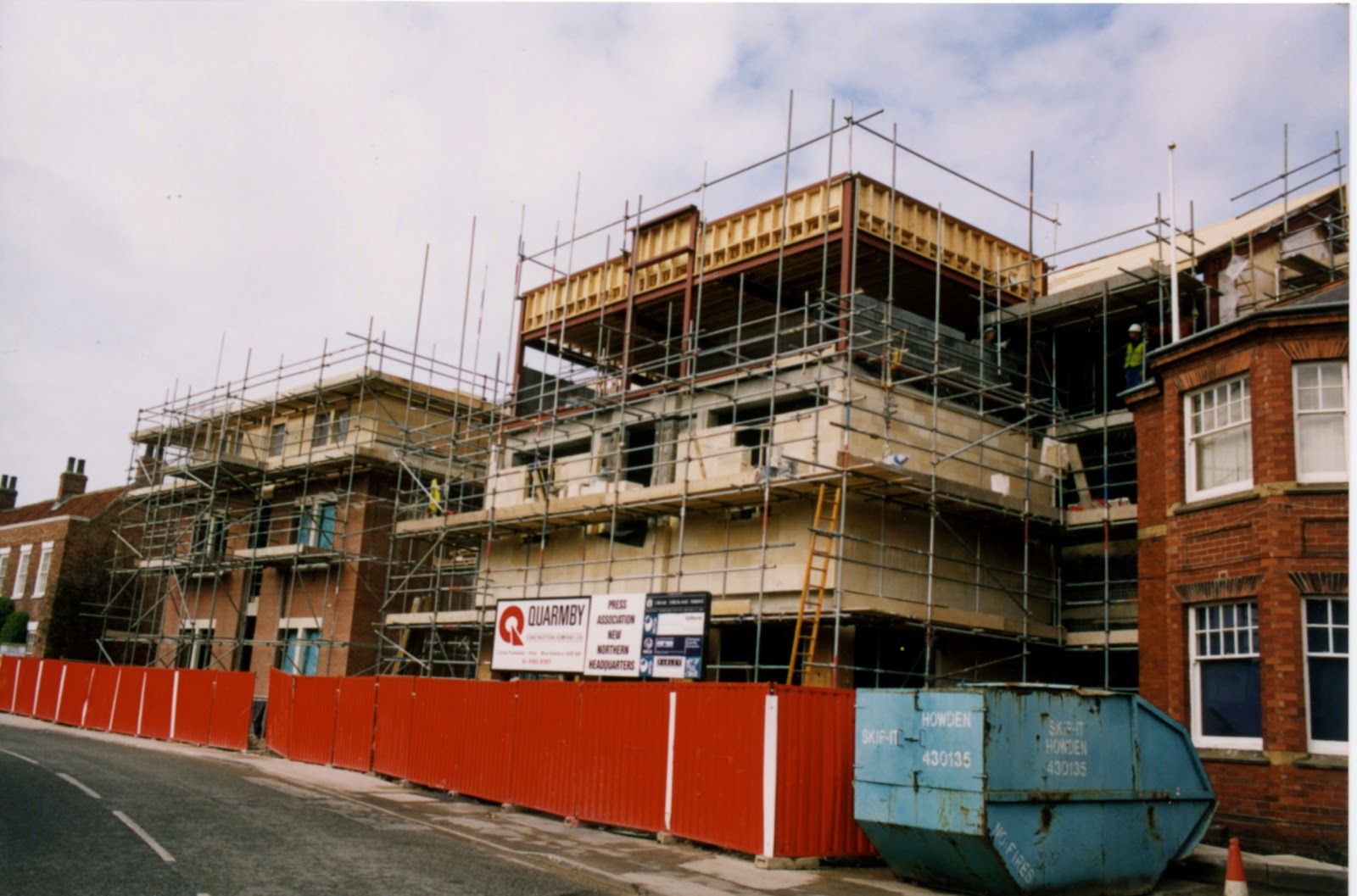
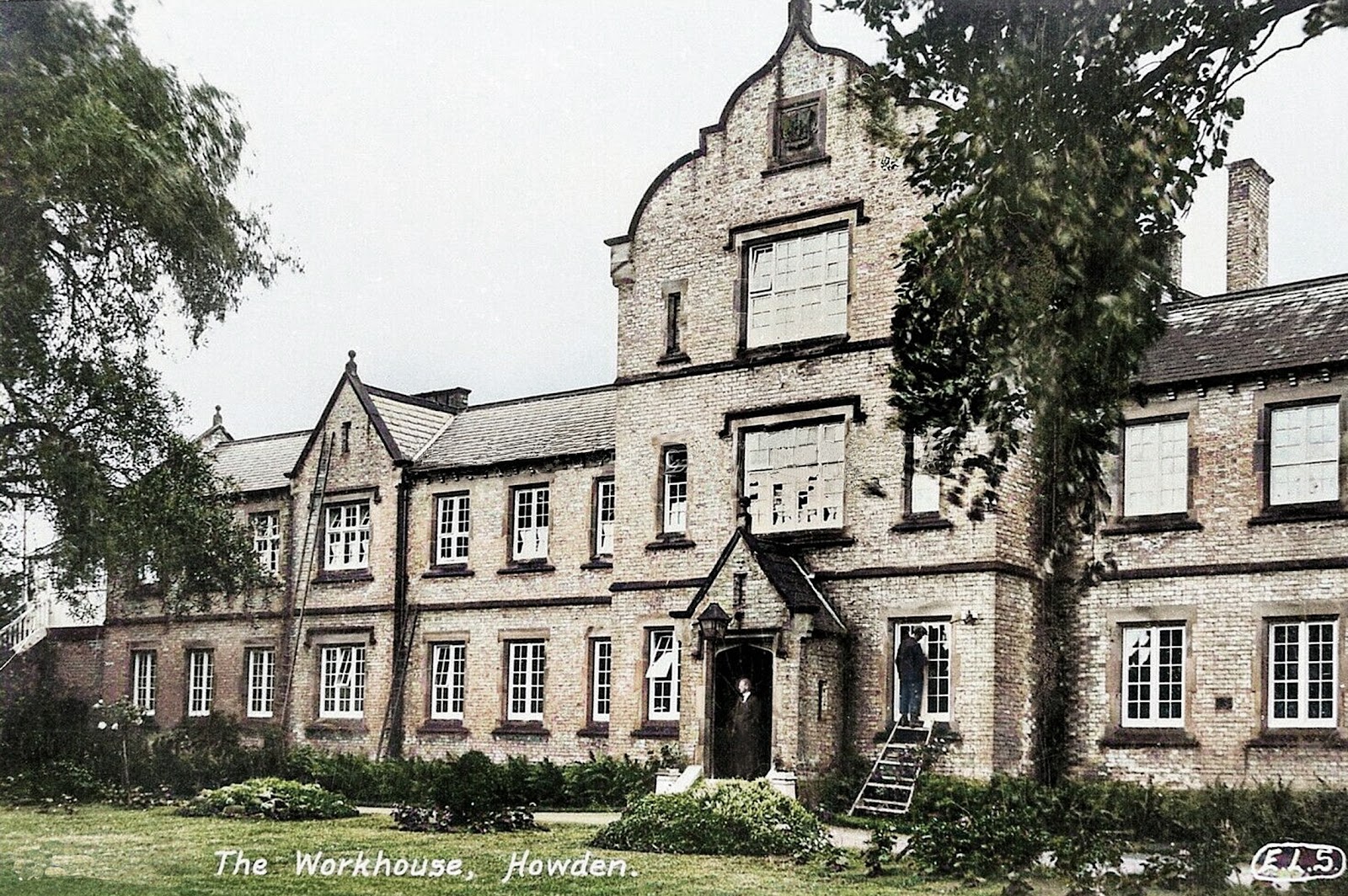
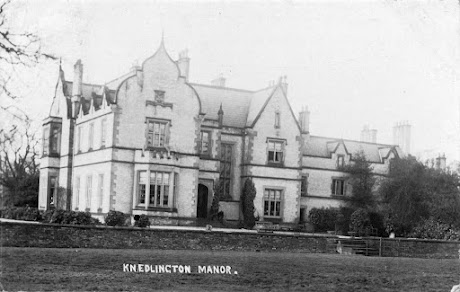
Thomas married in 1825, Sarah, eldest daughter of the Rev Eric Rudd of Thorne. The couple had four sons but only one survived their parents. Mr Clarke was prominent in local affairs and was involved with the restoration work of the church, the building of the Howden workhouse and the Shire Hall. He lived initially at Knedlington Old Hall but in 1841-2 he built a new hall which he called Knedlington Manor. It consisted of 33 rooms and was designed by Weightman and Hadfield of Sheffield in the Tudor style. There were formal grounds containing several American trees grown from seeds imported by William Cobbett, the famous 19th century pamphleteer and horticulturist.
After the death of Thomas Sinclair Clarke the estate passed to the Rudd family. The last of the Clarkes to live at Knedlington was Eric de Siobalde Sutherland Rudd-Clarke, who died in 1925. The Manor was sold in 1930 to James 'Jimmy' Mortimer, an entrepreneur! Mr Rudd Clarke's widow married Rev Waring, the vicar of Howden.
Thomas Clarke's Knedlington manor |
Knedlington Manor was demolished in the 1950s.
The other family I have been looking at is the Andertons who lived at Howdendyke and owned the chemical fertiliser works there. The first of the family to live there was George Anderton who bought the site in 1857 and built a fertiliser works there. Soon afterwards there was a tragedy when the new chimney at the works fell and killed seven workmen.
After George's death his son George Herbert took over. He had a younger brother, Frederick who died aged 19 a month after George celebrated his 21st birthday. GH was known as a benevolent employer. It was said that he never made any worker retire - as long as they could appear at the works they were paid even if they couldn't really work.
After his death in 1907 his widow Laura commissioned a new pulpit in Howden church in his memory. It was carved by Messrs Elwell of Beverley. It is of course still there and in use.
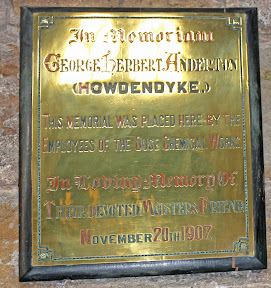
| The plaque to G H Anderton on the wall of Howden Minster erected by his workmen |
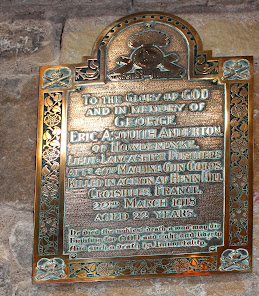
He had two children, Maud and Eric. Maud married Richard Pilling of Welton hall and this couple took over the works after Eric was killed aged 22 in 1918.
The Plaque to Eric Asquith Anderton in Howden Minster |
The family lived in Kilpin Lodge and 'ran' the village of Howdendyke until the late 1950s. There is still a fertiliser works there but many of the houses have been demolished.
It is an interesting commentary on how times have changed that local communities are rarely as influenced today by resident families as Knedlington and Howdendyke once were.
Saturday, 12 March 2022
Howden education, Howdendyke and Hook Road
Since my last post a lot has happened in the world. Covid seems to be something we are all learning to live with and instead we are all now watching the awful events in Ukraine. Not only is it a tragedy for all those being bombed and displaced but it is having a dramatic effect already here at home. I am gathering fallen branches ready for the woodburner as domestic heating oil prices have tripled and we don't have any gas out here in what The Times in an article called 'a remote community'.
More mundanely the garlic is doing well and we have put an upturned black dustbin over the rhubarb although not much is happening in there yet.
I have been preparing a presentation on education in Howden beginning with the Grammar school in the church and coming up to the present schools. The Howden senior school badge incorporates the original grammar school badge which in turn was the coat of arms of Walter Skirlaw, as well as referencing the horse fair, the market cross and Howden's connections with the bishop of Durham. It was designed by teacher and organist Ted Stockdale.
Earlier this week a friend and I walked around Howdendyke in preparation for a talk about the village at our small Skelton history group. So much of the village was demolished in order to make way for the fertiliser works to expand and it is difficult to work out where many of the old pictures we have were taken.
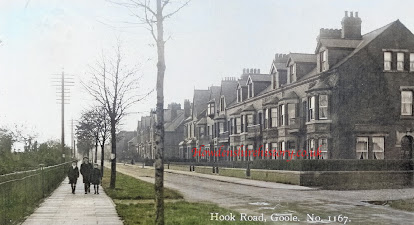
Meanwhile the other group I attend in Goole has spent several weeks moving slowly along Hook Road looking at the houses in a sort of version of a 'house through time'. Using newspaper and census records as well as pictures [ thanks to Gilbert Tawn who has photographed them all] we have looked at the dates and names of the houses and tried where we can to trace where their names were from and who lived in them.
We have also talked of Christ Church and its ministers, possibly also the site of an early Goole Grammar school, of Richard Cooper's original Phoenix iron foundry, a Palace of Varieties and Herons' mill.
This week we looked at Nunraw, so called as in 1923 it became the home of the Milner family. The family of course still has the florists' shop in Boothferry Road. An early Mrs Milner came from Nunraw in Scotland.
Let us hope that by the time I write my next blog post there will be peace in the Ukraine.
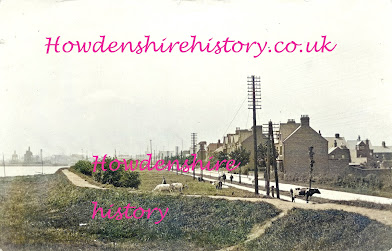
A very rural view of Goole's Hook Road |
Saturday, 19 February 2022
Snowdrops and Sandhall
I am sitting at the computer looking at the garden trees swaying gently in the wind. I think that Storm Eunice concentrated her fury in the south and let us off lightly. Although sometimes I wonder whether it is best not to follow these dramatic warnings and just wait for the weather to do its thing - as our forefathers did.
Our snowdrops have put on an excellent show this year and have spread even further than last year. The hellebores are not quite in flower and neither are the daffodils. But I have been buying seeds and am looking forward to getting some tomatoes started on the windowsill.
Saturday, 22 January 2022
Hook chapels
We are in a run of sunny, frosty weather, perfect for dog walking but not so good for the oil tank which will soon need re-filling. But we are seeing signs of spring. The snowdrops - and we have a lot - are just beginning to show white and the daffodil spikes are getting taller.
I have been busy loading pictures into my new website [ not yet online] and also looking at a family history which has been very interesting as the people all lived locally and it is easier to envisage their lives when I know the area. There is a lot can be found online about families, particularly on the old newspaper sites but nothing can beat being familiar with the towns and villages mentioned.
Last week the small local history group I attend in Goole met again after the Christmas break. We meet on a Thursday morning in the Oddfellows hall and talk about the history of Goole and the surrounding area. Some of us have been researching for many years and continue to do so, others just come to listen and join in the discussions and we have new members who have not long lived in the area. It is surprising what a wealth of knowledge there is around the table.
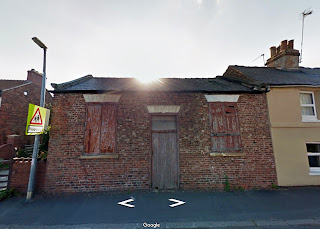
This week we were talking about Hook and its chapel[s]. One of our group had noticed this building which we thought was surely a former chapel. It looks like so many local chapels
| Hook |
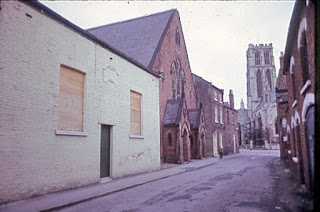
| Howden St John St |